


Page 154 - Towards Trustworthy Elections New Directions in Electronic Voting by Ed Gerck (auth.), David Chaum, Markus Jakobsson, Ronald L. Rivest, Peter Y. A. Ryan, Josh Benaloh, Miroslaw Kutylowski, Ben Adida ( (z-lib.org (1)
P. 154
J. Furukawa, K. Mori, and K. Sako
                          146
                                                            i
                                                      i
                           3. SC j will decrypt each of (G
                                                                               (j)
                                                                         (j)
                                                                  (j)
                                                        (j)
                                                                       i
                                               i
                                                                 i
                                                                              i
                                                       i
                                                                          = G
                                                         − [x j ]G
                                                                     G
                                          (j)  M     (j)  = M   (j) ,M    (j) ) using his secret key x j as follows:
                                                (j)
                             The list (G  i  ,M  i  ) i will be returned to the shuffling management center.
                          Proving Correctness
                          Details of procedure for mixers to prove they have correctly shuffled and de-
                          crypted the input is described in the next section.
                          3   Details of Correctness Proof
                          For simplicity, we concentrate on one shuffling center and denote his secret key
                          as x. We represent by ¯ the product of the public keys of subsequent centers.
                                              y
                          What we need to prove is the correctness of the following shuffle-and-decrypt
                          procedure.
                            Given n ciphertexts (G i ,M i ) i ,where all {G i } and {M i } are in E, the shuffling
                          center randomly chooses a permutation π and a random element s i ∈ U Z/qZ to
                          obtain shuffle-and-decrypt result as follows:


                                              i
                                          i
                                        (G ,M )= [s i ]g + G π(i) , [s i ]¯y + M π(i) − [x]G i
                          for i =1,... ,n.
                          3.1  Generation of the Proof
                          We now provide the scheme to generate a proof that the shuffling center (which
                          will be denoted as the prover in the sequel) indeed shuffled and decrypted honestly.
                            We describe the scheme in a non-interactive way, where a challenge from a
                          verifier is given as an output of some universal one-way hash functions. We as-
                          sume here that all elements of input ciphertexts (G i ,M i ) and output ciphertexts
                          (G ,M )are in E.


                            i   i


                            To prove (G ,M ) are generated correctly from (G i ,M i ), the prover computes
                                       i  i
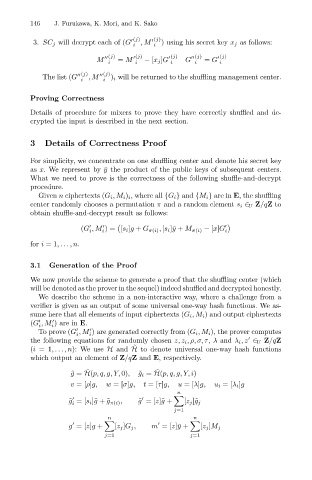
                          the following equations for randomly chosen z, z i ,ρ,σ,τ, λ and λ i ,z ∈ U Z/qZ

                                                      ˜
                          (i =1,... ,n): We use H and H to denote universal one-way hash functions
                          which output an element of Z/qZ and E, respectively.
                                                            ˜
                                         ˜              ˜ g i = H(p, q, g, Y, i)
                                     ˜ g = H(p, q, g, Y, 0),
                                     v =[ρ]g,  w =[σ]g,  t =[τ]g,  u =[λ]g,  u i =[λ i ]g
                                                                  n


                                                        ˜ g =[z]˜ +
                                     i
                                                                       g
                                    ˜ g =[s i ]˜g +˜g π(i) ,  g     [z j ]˜ j
                                                                 j=1
                                               n                       n


                                    g =[z]g +    [z j ]G j ,  m =[z]¯ +  [z j ]M j
                                                                  y
                                              j=1                     j=1

