


Page 159 - Towards Trustworthy Elections New Directions in Electronic Voting by Ed Gerck (auth.), David Chaum, Markus Jakobsson, Ronald L. Rivest, Peter Y. A. Ryan, Josh Benaloh, Miroslaw Kutylowski, Ben Adida ( (z-lib.org (1)
P. 159
An Implementation of a Mix-Net Based Network Voting Scheme
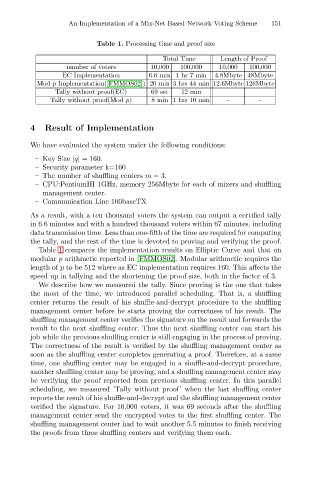
                                            Table 1. Processing time and proof size
                                                              Total Time
                                                                              Length of Proof
                                    number of voters       10,000  100,000    10,000  100,000 151
                                   EC Implementation       6.6 min 1 hr 7 min  4.8Mbyte 48Mbyte
                            Mod p Implementation([FMMOS02]) 20 min 3 hrs 44 min 12.6Mbyte 126Mbyte
                                 Tally without proof(EC)   69 sec  12 min       –        –
                               Tally without proof(Mod p)  8min 1 hrs 10 min    –        –
                          4   Result of Implementation

                          We have evaluated the system under the following conditions:

                           – Key Size |q| = 160.
                           – Security parameter k=160
                           – The number of shuffling centers m =3.
                           – CPU:PentiumIII 1GHz, memory 256Mbyte for each of mixers and shuffling
                             management center.
                           – Communication Line 100baseTX
                          As a result, with a ten thousand voters the system can output a certified tally
                          in 6.6 minutes and with a hundred thousand voters within 67 minutes, including
                          data transmission time. Less than one-fifth of the time are required for computing
                          the tally, and the rest of the time is devoted to proving and verifying the proof.
                            Table 1 compares the implementation results on Elliptic Curve and that on
                          modular p arithmetic reported in [FMMOS02]. Modular arithmetic requires the
                          length of p to be 512 where as EC implementation requires 160. This affects the
                          speed up in tallying and the shortening the proof size, both in the factor of 3.
                            We describe how we measured the tally. Since proving is the one that takes
                          the most of the time, we introduced parallel scheduling. That is, a shuffling
                          center returns the result of his shuffle-and-decrypt procedure to the shuffling
                          management center before he starts proving the correctness of his result. The
                          shuffling management center verifies the signature on the result and forwards the
                          result to the next shuffling center. Thus the next shuffling center can start his
                          job while the previous shuffling center is still engaging in the process of proving.
                          The correctness of the result is verified by the shuffling management center as
                          soon as the shuffling center completes generating a proof. Therefore, at a same
                          time, one shuffling center may be engaged in a shuffle-and-decrypt procedure,
                          another shuffling center may be proving, and a shuffling management center may
                          be verifying the proof reported from previous shuffling center. In this parallel
                          scheduling, we measured ’Tally without proof’ when the last shuffling center
                          reports the result of his shuffle-and-decrypt and the shuffling management center
                          verified the signature. For 10,000 voters, it was 69 seconds after the shuffling
                          management center send the encrypted votes to the first shuffling center. The
                          shuffling management center had to wait another 5.5 minutes to finish receiving
                          the proofs from three shuffling centers and verifying them each.

