


Page 156 - Towards Trustworthy Elections New Directions in Electronic Voting by Ed Gerck (auth.), David Chaum, Markus Jakobsson, Ronald L. Rivest, Peter Y. A. Ryan, Josh Benaloh, Miroslaw Kutylowski, Ben Adida ( (z-lib.org (1)
P. 156
J. Furukawa, K. Mori, and K. Sako
                          148
                                                                    n
                                                                         2

                                                                    j=1
                                                                               n
                                                                    n
                                                n

                                                     3   [λ ]g = u +    [c j ]u j
                                                          3
                                                                        2

                                   [λ ]t +[r]v +[  (r j − c j )]g =˙v +  [c j ] ˙ t j +  [c j ]˙v j
                                                j=1                j=1        j=1
                                                                     n
                                                          2
                                                     2
                                       [r]w +[sumj(r j − c j )]g =˙w +    [c j ]˙w j
                                                                    j=1

                                               [r ]g =[c ]y + y , [r ]ζ =[c ]η + η .
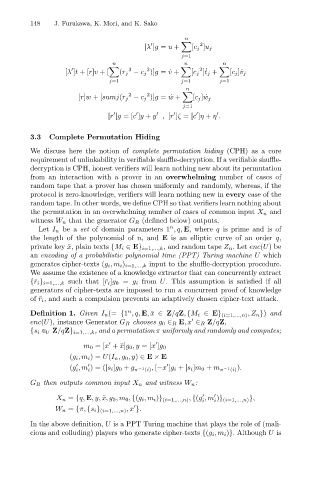
                          3.3  Complete Permutation Hiding
                          We discuss here the notion of complete permutation hiding (CPH) as a core
                          requirement of unlinkability in verifiable shuffle-decryption. If a verifiable shuffle-
                          decryption is CPH, honest verifiers will learn nothing new about its permutation
                          from an interaction with a prover in an overwhelming number of cases of
                          random tape that a prover has chosen uniformly and randomly, whereas, if the
                          protocol is zero-knowledge, verifiers will learn nothing new in every case of the
                          random tape. In other words, we define CPH so that verifiers learn nothing about
                          the permutation in an overwhelming number of cases of common input X n and
                          witness W n that the generator G R (defined below) outputs.
                                                                n
                            Let I n be a set of domain parameters 1 ,q, E,where q is prime and is of
                          the length of the polynomial of n,and E is an elliptic curve of an order q,
                          private key ¯, plain texts {M i ∈ E} i=1,...,k , and random tape Z n .Let enc(U)be
                                    x
                          an encoding of a probabilistic polynomial time (PPT) Turing machine U which
                          generates cipher-texts (g i ,m i ) i=1,...,k input to the shuffle-decryption procedure.
                          We assume the existence of a knowledge extractor that can concurrently extract
                          {¯ i } i=1,...,k such that [¯r i ]g 0 = g i from U. This assumption is satisfied if all
                           r
                          generators of cipher-texts are imposed to run a concurrent proof of knowledge
                          of ¯ i , and such a compulsion prevents an adaptively chosen cipher-text attack.
                            r
                                                     n
                          Definition 1. Given I n (= {1 ,q, E, ¯x ∈ Z/qZ, {M i ∈ E} (i=1,...,n) ,Z n }) and

                          enc(U), instance Generator G R chooses g 0 ∈ R E,x ∈ R Z/qZ,
                          {s i ∈ U Z/qZ} i=1,...,k , and a permutation π uniformly and randomly and computes;

                                         m 0 =[x +¯x]g 0 ,y =[x ]g 0
                                     (g i ,m i )= U(I n ,g 0,y) ∈ E × E

                                      i
                                          i
                                     (g ,m )= ([s i ]g 0 + g π −1 (i) , [−x ]g i +[s i ]m 0 + m π −1 (i) ).
                          G R then outputs common input X n and witness W n :

                                                                         i
                                                                             i
                                 X n = {q, E,y, ¯x, g 0 ,m 0 , {(g i ,m i )} (i=1,...,n) , {(g ,m )} (i=1,...,n) },

                                 W n = {π, {s i } (i=1,...,n) ,x }.
                          In the above definition, U is a PPT Turing machine that plays the role of (mali-
                          cious and colluding) players who generate cipher-texts {(g i ,m i )}. Although U is

