


Page 158 - Towards Trustworthy Elections New Directions in Electronic Voting by Ed Gerck (auth.), David Chaum, Markus Jakobsson, Ronald L. Rivest, Peter Y. A. Ryan, Josh Benaloh, Miroslaw Kutylowski, Ben Adida ( (z-lib.org (1)
P. 158
J. Furukawa, K. Mori, and K. Sako
                          150
                            Now we can say that a verifiable shuffle-decryption protocol hides its per-
                          mutations completely with respect to G R - i.e., CPH occurs - if there exists a
                                                                E
                                                                 (which has black box access to E )
                          probabilistic polynomial time algorithm E
                          with inputs X n and H(I n ,enc(U),X n ,π) that suffers no disadvantage with re-
                          spect to learning anything about the permutations compared to any probabilistic
                                                                  P
                                                                  V  and H(I n ,enc(U),X n ,π). This
                          polynomial time verifier E having input View
                          leads to,
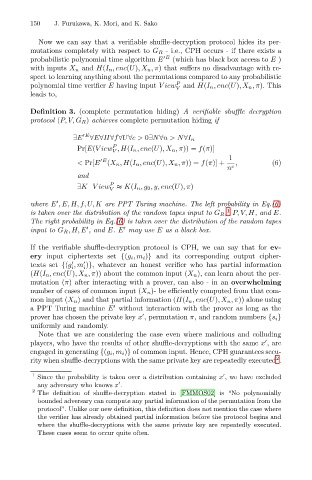
                          Definition 3. (complete permutation hiding) A verifiable shuffle decryption
                          protocol (P, V, G R ) achieves complete permutation hiding if
                                         E
                                          ∀E∀H∀f∀U∀c> 0∃N∀n> N∀I n
                                      ∃E
                                                 P
                                       Pr[E(View ,H(I n ,enc(U),X n ,π)) = f(π)]
                                                V
                                                                                 1
                                              E
                                                                                 c
                                       < Pr[E  (X n ,H(I n ,enc(U),X n,π)) = f(π)] +  ,     (6)
                                                                                n
                                       and
                                                P
                                       ∃KV iew ≈ K(I n ,g 0 ,y,enc(U),π)
                                                V

                          where E ,E,H,f,U,K are PPT Turing machine. The left probability in Eq.(6)
                                                                                1
                          is taken over the distribution of the random tapes input to G R , P, V, H,and E.
                          The right probability in Eq.(6) is taken over the distribution of the random tapes
                          input to G R ,H,E ,and E. E may use E as a black box.


                          If the verifiable shuffle-decryption protocol is CPH, we can say that for ev-
                          ery input ciphertexts set {(g i ,m i )} and its corresponding output cipher-

                          texts set {(g ,m )}, whatever an honest verifier who has partial information

                                     i   i
                          (H(I n ,enc(U),X n,π)) about the common input (X n ), can learn about the per-
                          mutation (π) after interacting with a prover, can also - in an overwhelming
                          number of cases of common input (X n )- be efficiently computed from that com-
                          mon input (X n ) and that partial information (H(I n ,enc(U),X n ,π)) alone using
                          a PPT Turing machine E without interaction with the prover as long as the


                          prover has chosen the private key x , permutation π, and random numbers {s i }
                          uniformly and randomly.
                            Note that we are considering the case even where malicious and colluding
                          players, who have the results of other shuffle-decryptions with the same x ,are

                          engaged in generating {(g i ,m i )} of common input. Hence, CPH guarantees secu-
                                                                                              2
                          rity when shuffle-decryptions with the same private key are repeatedly executed .
                          1
                            Since the probability is taken over a distribution containing x , we have excluded
                            any adversary who knows x .

                          2
                            The definition of shuffle-decryption stated in [FMMOS02] is “No polynomially
                            bounded adversary can compute any partial information of the permutation from the
                            protocol”. Unlike our new definition, this definition does not mention the case where
                            the verifier has already obtained partial information before the protocol begins and
                            where the shuffle-decryptions with the same private key are repeatedly executed.
                            These cases seem to occur quite often.

