


Page 157 - Towards Trustworthy Elections New Directions in Electronic Voting by Ed Gerck (auth.), David Chaum, Markus Jakobsson, Ronald L. Rivest, Peter Y. A. Ryan, Josh Benaloh, Miroslaw Kutylowski, Ben Adida ( (z-lib.org (1)
P. 157
An Implementation of a Mix-Net Based Network Voting Scheme
                          determined before the public parameter is generated, it does not lose generality
                          because it has this public parameter as an input. In a case where U realizes
                          honest players, it outputs
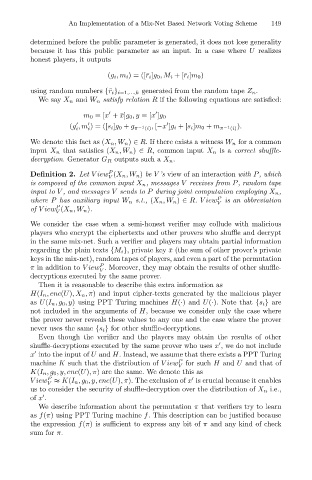
                                               (g i ,m i)=([¯r i ]g 0 ,M i +[¯r i ]m 0 )    149
                          using random numbers {¯ i} i=1,...,k generated from the random tape Z n .
                                               r
                            We say X n and W n satisfy relation R if the following equations are satisfied:

                                         m 0 =[x +¯x]g 0 ,y =[x ]g 0

                                     (g ,m )= ([s i ]g 0 + g π  −1 (i) , [−x ]g i +[s i]m 0 + m π −1
                                      i   i                                      (i) ).
                          We denote this fact as (X n ,W n ) ∈ R. If there exists a witness W n for a common
                          input X n that satisfies (X n ,W n ) ∈ R, common input X n is a correct shuffle-
                          decryption. Generator G R outputs such a X n .
                                               P
                          Definition 2. Let View (X n ,W n ) be V ’s view of an interaction with P,which
                                               V
                          is composed of the common input X n , messages V receives from P, random tape
                          input to V , and messages V sends to P during joint computation employing X n ,
                                                                             P
                          where P has auxiliary input W n s.t., (X n ,W n ) ∈ R. View V  is an abbreviation
                                 P
                          of View (X n ,W n ).
                                 V
                          We consider the case when a semi-honest verifier may collude with malicious
                          players who encrypt the ciphertexts and other provers who shuffle and decrypt
                          in the same mix-net. Such a verifier and players may obtain partial information
                          regarding the plain texts {M i },private key ¯x (the sum of other prover’s private
                          keys in the mix-net), random tapes of players, and even a part of the permutation
                                             P
                          π in addition to View . Moreover, they may obtain the results of other shuffle-
                                             V
                          decryptions executed by the same prover.
                            Then it is reasonable to describe this extra information as
                          H(I n ,enc(U),X n,π) and input cipher-texts generated by the malicious player
                          as U(I n ,g 0,y) using PPT Turing machines H(·)and U(·). Note that {s i } are
                          not included in the arguments of H, because we consider only the case where
                          the prover never reveals these values to any one and the case where the prover
                          never uses the same {s i } for other shuffle-decryptions.
                            Even though the verifier and the players may obtain the results of other
                          shuffle-decryptions executed by the same prover who uses x , we do not include

                          x into the input of U and H. Instead, we assume that there exists a PPT Turing

                                                                   P
                          machine K such that the distribution of View V  for such H and U and that of
                          K(I n ,g 0 ,y,enc(U),π) are the same. We denote this as
                               P
                          View ≈ K(I n ,g 0 ,y,enc(U),π). The exclusion of x is crucial because it enables

                               V
                          us to consider the security of shuffle-decryption over the distribution of X n i.e.,
                          of x .

                            We describe information about the permutation π that verifiers try to learn
                          as f(π) using PPT Turing machine f. This description can be justified because
                          the expression f(π) is sufficient to express any bit of π and any kind of check
                          sum for π.

