


Page 160 - Towards Trustworthy Elections New Directions in Electronic Voting by Ed Gerck (auth.), David Chaum, Markus Jakobsson, Ronald L. Rivest, Peter Y. A. Ryan, Josh Benaloh, Miroslaw Kutylowski, Ben Adida ( (z-lib.org (1)
P. 160
J. Furukawa, K. Mori, and K. Sako
                          152


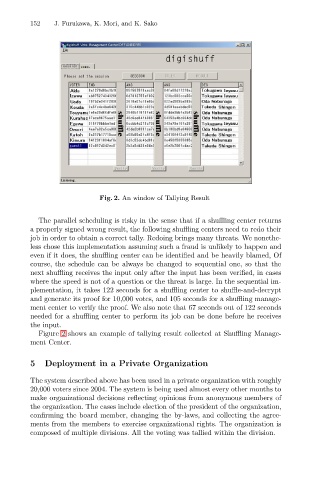
                                             Fig. 2. An window of Tallying Result


                            The parallel scheduling is risky in the sense that if a shuffling center returns
                          a properly signed wrong result, the following shuffling centers need to redo their
                          job in order to obtain a correct tally. Redoing brings many threats. We nonethe-
                          less chose this implementation assuming such a fraud is unlikely to happen and
                          even if it does, the shuffling center can be identified and be heavily blamed, Of
                          course, the schedule can be always be changed to sequential one, so that the
                          next shuffling receives the input only after the input has been verified, in cases
                          where the speed is not of a question or the threat is large. In the sequential im-
                          plementation, it takes 122 seconds for a shuffling center to shuffle-and-decrypt
                          and generate its proof for 10,000 votes, and 105 seconds for a shuffling manage-
                          ment center to verify the proof. We also note that 67 seconds out of 122 seconds
                          needed for a shuffling center to perform its job can be done before he receives
                          the input.
                            Figure 2 shows an example of tallying result collected at Shuffling Manage-
                          ment Center.


                          5   Deployment in a Private Organization

                          The system described above has been used in a private organization with roughly
                          20,000 voters since 2004. The system is being used almost every other months to
                          make organizational decisions reflecting opinions from anonymous members of
                          the organization. The cases include election of the president of the organization,
                          confirming the board member, changing the by-laws, and collecting the agree-
                          ments from the members to exercise organizational rights. The organization is
                          composed of multiple divisions. All the voting was tallied within the division.

