


Page 244 - Towards_a_New_Malaysia_The_2018_Election_and_Its_6146371_(z-lib.org)
P. 244
Malaysia’s First-Past-the-Post Electoral System              229

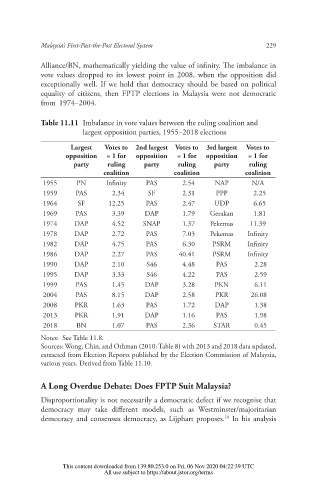
                  Alliance/BN, mathematically yielding the value of in nity.  e imbalance in
                  vote  values  dropped  to  its  lowest  point  in  2008,  when  the  opposition  did
                  exceptionally well. If we hold that democracy should be based on political
                  equality of citizens, then FPTP elections in Malaysia were not democratic
                  from 1974–2004.


                  Table 11.11  Imbalance in vote values between the ruling coalition and
                              largest opposition parties, 1955–2018 elections

                          Largest   Votes to  2nd largest  Votes to  3rd largest   Votes to
                         opposition   = 1 for   opposition   = 1 for   opposition   = 1 for
                           party    ruling    party    ruling    party    ruling
                                   coalition          coalition          coalition
                   1955     PN      In nity    PAS       2.54    NAP       N/A
                   1959     PAS       2.34     SF        2.31    PPP         2.25
                   1964     SF      12.25      PAS       2.47    UDP         6.65
                   1969     PAS       3.39    DAP        1.79   Gerakan      1.81
                   1974    DAP        4.52    SNAP       1.37   Pekemas    11.39
                   1978    DAP        2.72     PAS       7.03   Pekemas   In nity
                   1982    DAP        4.75     PAS       6.30    PSRM     In nity
                   1986    DAP        2.27     PAS     40.41     PSRM     In nity
                   1990    DAP        2.10     S46       4.48     PAS        2.28
                   1995    DAP        3.33     S46       4.22     PAS        2.59
                   1999     PAS       1.45    DAP        3.28    PKN         6.11
                   2004     PAS       8.15    DAP        2.58    PKR       26.08
                   2008    PKR        1.63     PAS       1.72    DAP         1.38
                   2013    PKR        1.91    DAP        1.16     PAS        1.98
                   2018     BN        1.07     PAS       2.36    STAR        0.45
                  Notes:  See Table 11.8.
                  Sources: Wong, Chin, and Othman (2010: Table 8) with 2013 and 2018 data updated,
                  extracted from Election Reports published by the Election Commission of Malaysia,
                  various years. Derived from Table 11.10.


                  A Long Overdue Debate: Does FPTP Suit Malaysia?
                  Disproportionality is not necessarily a democratic defect if we recognise that
                  democracy may take di erent models, such as  Westminster/majoritarian
                  democracy and consensus democracy, as Lijphart proposes.  In his analysis
                                                                    10


                        This content downloaded from 139.80.253.0 on Fri, 06 Nov 2020 04:22:39 UTC
                                   All use subject to https://about.jstor.org/terms

