


Page 249 - Towards_a_New_Malaysia_The_2018_Election_and_Its_6146371_(z-lib.org)
P. 249
234                                                 Wong Chin Huat

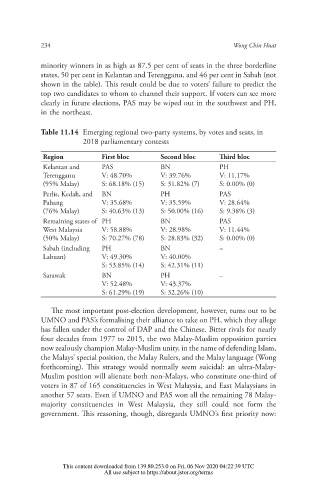
                  minority winners in as high as 87.5 per cent of seats in the three borderline
                  states, 50 per cent in Kelantan and Terengganu, and 46 per cent in Sabah (not
                  shown in the table).  is result could be due to voters’ failure to predict the
                  top two candidates to whom to channel their support. If voters can see more
                  clearly in future elections, PAS may be wiped out in the southwest and PH,
                  in the northeast.

                  Table 11.14  Emerging regional two-party systems, by votes and seats, in
                              2018 parliamentary contests
                   Region          First bloc      Second bloc     ird bloc
                   Kelantan and    PAS             BN             PH
                   Terengganu      V: 48.70%       V: 39.76%      V: 11.17%
                   (95% Malay)     S: 68.18% (15)  S: 31.82% (7)  S: 0.00% (0)
                   Perlis, Kedah, and   BN         PH             PAS
                   Pahang          V: 35.68%       V: 35.59%      V: 28.64%
                   (76% Malay)     S: 40.63% (13)  S: 50.00% (16)  S: 9.38% (3)
                   Remaining states of  PH         BN             PAS
                   West Malaysia   V: 58.88%       V: 28.98%      V: 11.44%
                   (50% Malay)     S: 70.27% (78)  S: 28.83% (32)  S: 0.00% (0)
                   Sabah (including   PH           BN             –
                   Labuan)         V: 49.30%       V: 40.00%
                                   S: 53.85% (14)  S: 42.31% (11)
                   Sarawak         BN              PH             –
                                   V: 52.48%       V: 43.37%
                                   S: 61.29% (19)  S: 32.26% (10)

                      e most important post-election development, however, turns out to be
                  UMNO and PAS’s formalising their alliance to take on PH, which they allege
                  has fallen under the control of DAP and the Chinese. Bitter rivals for nearly
                  four decades from 1977 to 2015, the two Malay-Muslim opposition parties
                  now zealously champion Malay-Muslim unity, in the name of defending Islam,
                  the Malays’ special position, the Malay Rulers, and the Malay language (Wong
                  forthcoming).  is strategy would normally seem suicidal: an ultra-Malay-
                  Muslim position will alienate both non-Malays, who constitute one-third of
                  voters in 87 of 165 constituencies in West Malaysia, and East Malaysians in
                  another 57 seats. Even if UMNO and PAS won all the remaining 78 Malay-
                  majority constituencies in  West Malaysia, they still could not form the
                  government.  is reasoning, though, disregards UMNO’s  rst priority now:


                        This content downloaded from 139.80.253.0 on Fri, 06 Nov 2020 04:22:39 UTC
                                   All use subject to https://about.jstor.org/terms

