


Page 248 - Towards_a_New_Malaysia_The_2018_Election_and_Its_6146371_(z-lib.org)
P. 248
Malaysia’s First-Past-the-Post Electoral System              233

                  why opposition parties had formed united fronts to capitalise on UMNO’s
                  schisms and why the Borneo parties left BN.
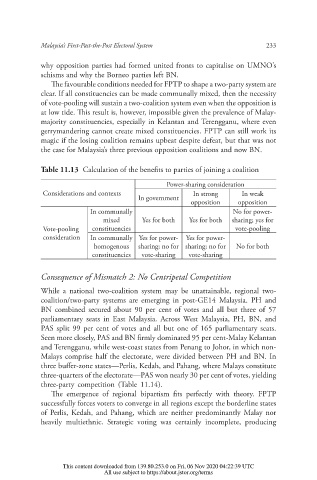
                      e favourable conditions needed for FPTP to shape a two-party system are
                  clear. If all constituencies can be made communally mixed, then the necessity
                  of vote-pooling will sustain a two-coalition system even when the opposition is
                  at low tide.  is result is, however, impossible given the prevalence of Malay-
                  majority constituencies, especially in Kelantan and Terengganu, where even
                  gerrymandering cannot create mixed constituencies. FPTP can still work its
                  magic if the losing coalition remains upbeat despite defeat, but that was not
                  the case for Malaysia’s three previous opposition coalitions and now BN.


                  Table 11.13  Calculation of the bene ts to parties of joining a coalition
                                                    Power-sharing consideration
                   Considerations and contexts             In strong    In weak
                                             In government
                                                           opposition  opposition
                                In communally                         No for power-
                                   mixed      Yes for both  Yes for both  sharing; yes for
                   Vote-pooling   constituencies                       vote-pooling
                   consideration  In communally  Yes for power-  Yes for power-
                                 homogenous   sharing; no for  sharing; no for   No for both
                                constituencies  vote-sharing  vote-sharing

                  Consequence of Mismatch 2: No Centripetal Competition

                  While a national two-coalition system may be unattainable, regional two-
                  coalition/two-party systems are emerging in post-GE14 Malaysia. PH and
                  BN combined secured about 90 per cent of votes and all but three of 57
                  parliamentary seats in East Malaysia. Across West Malaysia, PH, BN, and
                  PAS split 99 per cent of votes and all but one of 165 parliamentary seats.
                  Seen more closely, PAS and BN  rmly dominated 95 per cent-Malay Kelantan
                  and Terengganu, while west-coast states from Penang to Johor, in which non-
                  Malays comprise half the electorate, were divided between PH and BN. In
                  three bu er-zone states—Perlis, Kedah, and Pahang, where Malays constitute
                  three-quarters of the electorate—PAS won nearly 30 per cent of votes, yielding
                  three-party  competition  (Table  11.14).
                      e emergence of regional bipartism  ts perfectly with theory. FPTP
                  successfully forces voters to converge in all regions except the borderline states
                  of Perlis, Kedah, and Pahang, which are neither predominantly Malay nor
                  heavily multiethnic. Strategic voting was certainly incomplete, producing


                        This content downloaded from 139.80.253.0 on Fri, 06 Nov 2020 04:22:39 UTC
                                   All use subject to https://about.jstor.org/terms

