


Page 38 - Elementary Algebra Exercise Book I
P. 38
ELEMENTARY ALGEBRA EXERCISE BOOK I                                           reAl numBers


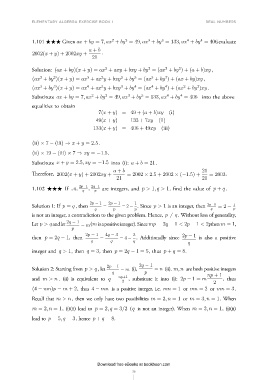
               1.101     Given ax + by =7, ax + by = 49, ax + by = 133, ax + by = 406 , evaluate
                                                   2
                                                                   3
                                                                                    4
                                                                                          4
                                                         2
                                                                         3
                                         a + b
               2002(x + y) + 2002xy +         .
                                          21
               Solution:  (ax + by)(x + y)= ax + axy + bxy + by =(ax + by ) + (a + b)xy ,
                                                                          2
                                                                   2
                                                                                 2
                                                2
               (ax + by )(x + y)= ax + ax y + bxy + by =(ax + by ) + (ax + by)xy ,
                                                       2
                                                             3
                         2
                                                                    3
                   2
                                              2
                                                                          3
                                        3
               (ax + by )(x + y)= ax + ax y + bxy + by =(ax + by ) + (ax + by )xy .
                                        4
                                                       3
                                              3
                                                             4
                                                                                   2
                                                                                         2
                                                                          4
                   3
                         3
                                                                    4
               Substitute  ax + by =7, ax + by = 49, ax + by = 133, ax + by = 406  into the above
                                                                3
                                                                           4
                                          2
                                                          3
                                                2
                                                                                 4
               equalities to obtain
                                             7(x + y) = 49 + (a + b)xy      (i)
                                            49(x + y) = 133 + 7xy       (ii)
                                          133(x + y) = 406 + 49xy        (iii)
               (ii) × 7 − (iii) ⇒ x + y =2.5.
               (ii) × 19 − (iii) × 7 ⇒ xy = −1.5.
               Substitute  x + y =2.5, xy = −1.5 into (i):  a + b = 21.
                                                   a + b                                   21
               Therefore,  2002(x + y) + 2002xy +        = 2002 × 2.5 + 2002 × (−1.5) +       = 2003.
                                                     21                                    21
                                        ,
               1.102      If  , q,  2p−1 2q−1  are integers, and  p> 1,q > 1, find the value of  p + q .
                                           p
                                      q
                                                             1
               Solution 1: If  p = q , then  2p − 1  =  2p − 1  =2 − . Since  p> 1 is an integer, then  2p−1  =2 −
                                                                                                         1
                                           q       p         p                                 q         p
               is not an integer, a contradiction to the given problem. Hence, p  = q . Without loss of generality,
               Let p>q and let  2q − 1  = m  (m is a positive integer). Since mp =2q − 1 < 2p − 1 < 2p , then m =1,
                                 p
                                                            3
               then  p =2q − 1, then   2p − 1  =  4q − 3  =4 − . Additionally since   2p − 1  is also a positive
                                         q        q         q                        q
               integer and  q> 1, then  q =3, then  p =2q − 1= 5, thus  p + q =8.
               Solution 2: Starting from  p>q, let  2p − 1  = m (i),  2q − 1  = n (ii). m, n  are both positive integers
                                                   q             p                           np +1
               and  m>n . (ii) is equivalent to  q =  np+1 , substitute it into (i):  2p − 1= m     , thus
                                                       2                                        2
               (4 − mn)p = m +2, thus  4 − mn  is a positive integer, i.e.  mn =1 or  mn =2 or  mn =3.
               Recall that  m>n, then we only have two possibilities  m =2,n =1 or  m =3,n =1. When
               m =2,n =1, (i)(ii) lead to  p =2,q =3/2 (q is not an integer). When  m =3,n =1, (i)(ii)

               lead to  p =5,q =3, hence  p + q =8.


                                            Download free eBooks at bookboon.com
                                                            38

