


Page 128 - Basic Principles of Textile Coloration
P. 128
PHYSICAL AND CHEMICAL PROPERTIES OF WOOL 117

depending upon which part of the sheep’s body they came from and upon the
conditions that existed during growth. Merino wool fibres are very fine (17–25 mm
diameter) but not very long (60–100 mm), whereas a Lincoln wool is courser
(around 40 mm diameter) but much longer (175–250 mm). Wool is graded into
various qualities, usually based on the finest yarn that can be spun from it. This
depends on the fibre thickness and staple length. The worsted count is the
number of hanks containing 560 yards of yarn that can be spun from 1 lb of wool
fibre. Thus, 1 lb of a worsted yarn with a 100 count would be 560 ´ 100 yards long.
This is the same as 8.9 tex (g km–1). The length of yarn in a hank for the woollen
count varies from place to place, being in the range 100–320 yd. The quality
assessment also includes evaluation of the degree of crimp, which is higher for
better qualities, and of the lustre and colour. High quality wool is usually free of
kemps. These are abnormal fibres with a horny sheath extending into the cortex
that resist dye penetration and can give unlevel coloration.

   Wool fineness can be assessed by determination of the average fibre diameter
using a projected image from a microscope, but requires examination of many
fibres. Alternatively, the air flow method used for evaluating the fineness of cotton
fibres can be used (see reference 4, chapter 5).

   Virgin wool is very expensive, particularly for the better qualities. The chemical
treatments that prevent shrinkage and felting on repeated washing of wool fabrics
add to the cost. Wool consumption is now only a small fraction of the total for all
fibres, and, because of its high price, many articles contain recycled wool.

   Wool is used for three major types of fabrics: woollen, worsted and felts. The
latter have fibres matted and pressed together with a random arrangement.
Woollen and worsted materials are produced using different carding and spinning
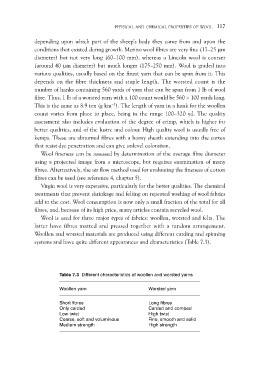
systems and have quite different appearances and characteristics (Table 7.3).

Table 7.3 Different characteristics of woollen and worsted yarns

Woollen yarn                 Worsted yarn

Short fibres                 Long fibres
Only carded                  Carded and combed
Low twist                    High twist
Coarse, soft and voluminous  Fine, smooth and solid
Medium strength              High strength

