


Page 132 - Basic Principles of Textile Coloration
P. 132
PHYSICAL AND CHEMICAL PROPERTIES OF WOOL 121

wrapper, is set by passing steam through it. In crabbing, the roll of wool fabric is
immersed in boiling or hot water and kept under tension as the water cools.
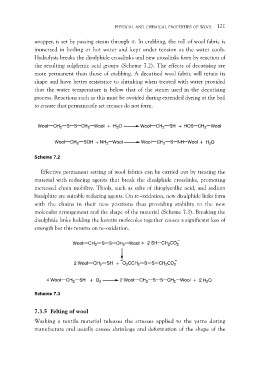
Hydrolysis breaks the disulphide crosslinks and new crosslinks form by reaction of
the resulting sulphenic acid groups (Scheme 7.2). The effects of decatising are
more permanent than those of crabbing. A decatised wool fabric will retain its
shape and have better resistance to shrinking when treated with water provided
that the water temperature is below that of the steam used in the decatising
process. Reactions such as this must be avoided during extended dyeing at the boil
to ensure that permanently set creases do not form.

Wool CH2 S S CH2 Wool + H2O  Wool CH2 SH + HOS CH2 Wool

Wool CH2 SOH + NH2 Wool      Wool CH2 S NH Wool + H2O

Scheme 7.2

   Effective permanent setting of wool fabrics can be carried out by treating the
material with reducing agents that break the disulphide crosslinks, promoting
increased chain mobility. Thiols, such as salts of thioglycollic acid, and sodium
bisulphite are suitable reducing agents. On re-oxidation, new disulphide links form
with the chains in their new positions thus providing stability to the new
molecular arrangement and the shape of the material (Scheme 7.3). Breaking the
disulphide links holding the keratin molecules together causes a significant loss of
strength but this returns on re-oxidation.

            Wool CH2 S S CH2 Wool + 2 SH CH2CO2

            2 Wool CH2 SH + O2CCH2 S S CH2CO2

        4 Wool CH2 SH + O2  2 Wool CH2 S S CH2 Wool + 2 H2O
Scheme 7.3

7.3.5 Felting of wool

Washing a textile material releases the stresses applied to the yarns during
manufacture and usually causes shrinkage and deformation of the shape of the

