


Page 130 - Basic Principles of Textile Coloration
P. 130
PHYSICAL AND CHEMICAL PROPERTIES OF WOOL 119

For wool, the numbers of amino and carboxylic acid groups are nearly equal, being
about 820 and 770 mmol kg–1, respectively. In electrically neutral wool, these are
present as ammonium and carboxylate ion groups.

   For a protein, the isoelectric point is defined as the pH value where the fibre
contains equal numbers of anionic and cationic groups, and has a value of around
5.5 for wool. In acidic solution, the carboxylate ions combine with protons to form
neutral carboxylic acid groups and the ammonium ion groups make the fibre
cationic. Conversely, in alkaline solution, reaction with hydroxide ions converts
ammonium ion to amino groups and the fibre becomes anionic (Table 7.4).
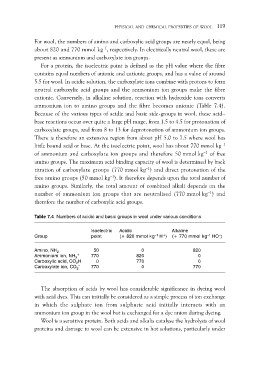
Because of the various types of acidic and basic side-groups in wool, these acid–
base reactions occur over quite a large pH range, from 1.5 to 4.5 for protonation of
carboxylate groups, and from 8 to 13 for deprotonation of ammonium ion groups.
There is therefore an extensive region from about pH 5.0 to 7.5 where wool has
little bound acid or base. At the isoelectric point, wool has about 770 mmol kg–1
of ammonium and carboxylate ion groups and therefore 50 mmol kg–1 of free
amino groups. The maximum acid binding capacity of wool is determined by back
titration of carboxylate groups (770 mmol kg–1) and direct protonation of the
free amino groups (50 mmol kg–1). It therefore depends upon the total number of
amino groups. Similarly, the total amount of combined alkali depends on the
number of ammonium ion groups that are neutralised (770 mmol kg–1) and
therefore the number of carboxylic acid groups.

Table 7.4 Numbers of acidic and basic groups in wool under various conditions

                       Isoelectric Acidic        Alkaline

Group                  point  (+ 820 mmol kg–1 H+) (+ 770 mmol kg–1 HO–)

Amino, NH2              50                    0            820
Ammonium ion, NH3+     770                 820                0
Carboxylic acid, CO2H                      770                0
Carboxylate ion, CO2–     0
                       770                    0            770

   The absorption of acids by wool has considerable significance in dyeing wool
with acid dyes. This can initially be considered as a simple process of ion exchange
in which the sulphate ion from sulphuric acid initially interacts with an
ammonium ion group in the wool but is exchanged for a dye anion during dyeing.

   Wool is a sensitive protein. Both acids and alkalis catalyse the hydrolysis of wool
proteins and damage to wool can be extensive in hot solutions, particularly under

