


Page 134 - Basic Principles of Textile Coloration
P. 134
WOOL PROCESSING 123

scouring must be carried out gently, using the lowest temperature, the mildest
alkali and mechanical action, and for times as short as 15 min. If milling and
scouring are combined, somewhat more vigorous conditions apply. Alternatively,
oils can be eliminated by treating the goods in a rotating perforated drum machine
using an organic solvent such as perchloroethylene (tetrachloroethene). It is also
possible to achieve some felting under these conditions by adding water to the
organic solvent. Suitable auxiliary chemicals keep this in fine suspension during
the solvent treatment. Whatever process is used, effective elimination of the oil, in
a completely uniform manner, is an essential prerequisite to level dyeing.

7.4.2 Means of eliminating wool shrinkage
A variety of methods produce wool fabrics that withstand repeated washing
without shrinkage and felting. They are particularly important for knitted woollens
and worsted fabrics. Two main principles are used:
(1) modification of the scale structure of the fibre cuticle to decrease the

      directional friction effect – this can be achieved by chemical treatments that
      either partially remove the scales or cover them with a smooth film of
      polymer;
(2) reduction of fibre mobility by adhesion of fibres and yarns at their points of
      contact and by decreasing fibre elasticity by means of intermolecular
      crosslinking.

Treatment of wool with chlorine attacks the scales of the cuticle and gives fibres
with a smoother surface and a fabric with improved shrink resistance. This is done
by treating a scoured wool fabric with dilute HCl solution at room temperature,
draining, and then running the goods in water slowly adding sodium hypochlorite
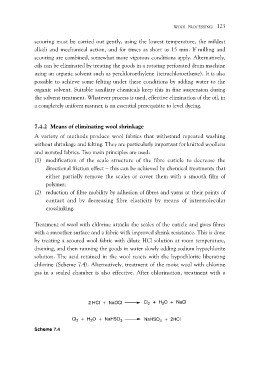
solution. The acid retained in the wool reacts with the hypochlorite liberating
chlorine (Scheme 7.4). Alternatively, treatment of the moist wool with chlorine
gas in a sealed chamber is also effective. After chlorination, treatment with a

            2 HCl + NaOCl       Cl2 + H2O + NaCl
                                NaHSO4 + 2HCl
            Cl2 + H2O + NaHSO3

Scheme 7.4

