


Page 15 - Basic Principles of Textile Coloration
P. 15
4 AN INTRODUCTION TO TEXTILES, DYES AND DYEING

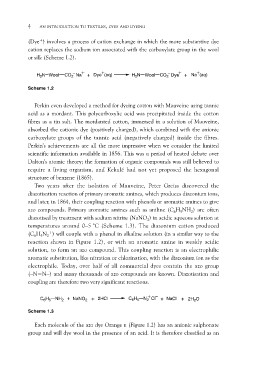
(Dye+) involves a process of cation exchange in which the more substantive dye
cation replaces the sodium ion associated with the carboxylate group in the wool
or silk (Scheme 1.2).

H2N Wool         _  Na+  +  Dye+(aq)  H2N  Wool       _  Dye+  +  Na+(aq)
            CO2                                  CO2

Scheme 1.2

   Perkin even developed a method for dyeing cotton with Mauveine using tannic
acid as a mordant. This polycarboxylic acid was precipitated inside the cotton
fibres as a tin salt. The mordanted cotton, immersed in a solution of Mauveine,
absorbed the cationic dye (positively charged), which combined with the anionic
carboxylate groups of the tannic acid (negatively charged) inside the fibres.
Perkin’s achievements are all the more impressive when we consider the limited
scientific information available in 1856. This was a period of heated debate over
Dalton’s atomic theory; the formation of organic compounds was still believed to
require a living organism, and Kekulé had not yet proposed the hexagonal
structure of benzene (1865).

   Two years after the isolation of Mauveine, Peter Greiss discovered the
diazotisation reaction of primary aromatic amines, which produces diazonium ions,
and later, in 1864, their coupling reaction with phenols or aromatic amines to give
azo compounds. Primary aromatic amines such as aniline (C6H5NH2) are often
diazotised by treatment with sodium nitrite (NaNO2) in acidic aqueous solution at
temperatures around 0–5 °C (Scheme 1.3). The diazonium cation produced
(C6H5N2+) will couple with a phenol in alkaline solution (in a similar way to the
reaction shown in Figure 1.2), or with an aromatic amine in weakly acidic
solution, to form an azo compound. This coupling reaction is an electrophilic
aromatic substitution, like nitration or chlorination, with the diazonium ion as the
electrophile. Today, over half of all commercial dyes contain the azo group
(–N=N–) and many thousands of azo compounds are known. Diazotisation and
coupling are therefore two very significant reactions.

        C6H5 NH2 + NaNO2 + 2HCl       C6H5 N2+Cl_ + NaCl + 2H2O
Scheme 1.3

   Each molecule of the azo dye Orange II (Figure 1.2) has an anionic sulphonate
group and will dye wool in the presence of an acid. It is therefore classified as an

