


Page 16 - Basic Principles of Textile Coloration
P. 16
HISTORICAL BACKGROUND     5

acid dye. In acidic solution, both the amino and carboxylate groups in wool bond
with protons, becoming cationic (NH3+) and neutral (CO2H), respectively. Under
these conditions, the wool absorbs anionic dyes (Dye–), such as Orange II, by a

process of anion exchange (Scheme 1.4).

            O3S                               O3S           Orange II

                               NH3                          N OH
                                                            N
                Step 1                         Step 2
            Diazotisation                     Coupling
            NaNO2/HCl                         pH 9–10

                0–5 °C                                  OH

            O3S
                                           +

                                NN

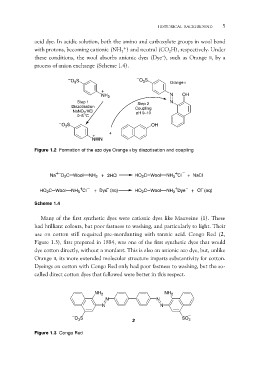
Figure 1.2 Formation of the azo dye Orange II by diazotisation and coupling

Na+_O2C Wool NH2 + 2HCl                       HO2C Wool NH3+Cl _ + NaCl

HO2C Wool   NH3+Cl _                   _      HO2C Wool     NH3+Dye_    +      _
                               + Dye (aq)                                    Cl (aq)

Scheme 1.4

   Many of the first synthetic dyes were cationic dyes like Mauveine (1). These
had brilliant colours, but poor fastness to washing, and particularly to light. Their
use on cotton still required pre-mordanting with tannic acid. Congo Red (2,
Figure 1.3), first prepared in 1884, was one of the first synthetic dyes that would
dye cotton directly, without a mordant. This is also an anionic azo dye, but, unlike
Orange II, its more extended molecular structure imparts substantivity for cotton.
Dyeings on cotton with Congo Red only had poor fastness to washing, but the so-
called direct cotton dyes that followed were better in this respect.

                               NH2                                 NH2
                                      N                       N

                                   N                            N

                          O3S                 2 SO3
Figure 1.3 Congo Red

