


Page 17 - Basic Principles of Textile Coloration
P. 17
6 AN INTRODUCTION TO TEXTILES, DYES AND DYEING

Synthetic Indigo was first prepared in 1880 and produced commercially in 1897.

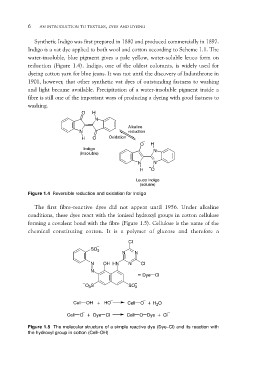
Indigo is a vat dye applied to both wool and cotton according to Scheme 1.1. The

water-insoluble, blue pigment gives a pale yellow, water-soluble leuco form on

reduction (Figure 1.4). Indigo, one of the oldest colorants, is widely used for

dyeing cotton yarn for blue jeans. It was not until the discovery of Indanthrone in

1901, however, that other synthetic vat dyes of outstanding fastness to washing

and light became available. Precipitation of a water-insoluble pigment inside a

fibre is still one of the important ways of producing a dyeing with good fastness to

washing.

          OH
                  N

          N                          Alkaline   H
           HO                        reduction   N
                       Oxidation
             Indigo
          (insoluble)                      O

                                 NN
                                  HO

                                                                                 Leuco Indigo
                                                                                    (soluble)

Figure 1.4 Reversible reduction and oxidation for Indigo

   The first fibre-reactive dyes did not appear until 1956. Under alkaline
conditions, these dyes react with the ionised hydroxyl groups in cotton cellulose
forming a covalent bond with the fibre (Figure 1.5). Cellulose is the name of the
chemical constituting cotton. It is a polymer of glucose and therefore a

                            Cl

          SO3               NN

          N OH HN N Cl
          N

                                         = Dye Cl

          O3S               SO3

              Cell OH + HO  Cell O + H2O
          Cell O + Dye Cl   Cell O Dye + Cl

Figure 1.5 The molecular structure of a simple reactive dye (Dye–Cl) and its reaction with
the hydroxyl group in cotton (Cell–OH)

