


Page 18 - Basic Principles of Textile Coloration
P. 18
HISTORICAL BACKGROUND  7

polyalcohol. It is conveniently represented by the short formula Cell–OH. The
strong bond between the reactive dye and the cellulose ensures good fastness to
washing and the simple chemical structures of the dyes often result in bright
colours. Dyes with simple molecular structures can often be prepared with a
minimum of contaminating isomers and by-products that tend to dull the colour.
Inducing a chemical reaction between a fibre and an absorbed dye molecule is
another significant way of producing dyeings of good washing fastness. Reactive
dyes have become one of the most important types of dye for dyeing cotton and
some types are valuable for wool dyeing.

   Synthetic dyes, obtained from coal tar and petroleum chemicals, have totally
replaced natural dyes. It would be quite impossible to meet even a small fraction of
today’s market requirements for colour using only naturally occurring dyes,
although a few are still used to colour foods and cosmetics. Since the earliest days
of the synthetic dyestuff industry, there has been a constant demand for dyes with
brighter colours, and with better fastness properties, for an increasing range of
fibre types. Of the many thousands of known synthetic dyes, only a few thousand
are manufactured today. They represent the market-driven selection of those with
the required performance.

   Before the twentieth century, textiles were made exclusively from natural fibres
such as cotton or wool. The first artificially made fibre of regenerated cellulose was
Chardonnet’s artificial silk, first produced in 1884. This was manufactured from
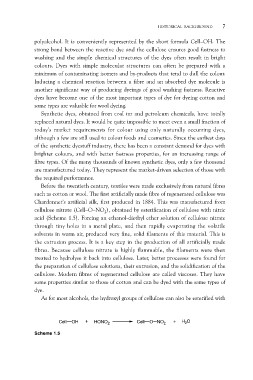
cellulose nitrate (Cell–O–NO2), obtained by esterification of cellulose with nitric
acid (Scheme 1.5). Forcing an ethanol-diethyl ether solution of cellulose nitrate
through tiny holes in a metal plate, and then rapidly evaporating the volatile
solvents in warm air, produced very fine, solid filaments of this material. This is
the extrusion process. It is a key step in the production of all artificially made
fibres. Because cellulose nitrate is highly flammable, the filaments were then
treated to hydrolyse it back into cellulose. Later, better processes were found for
the preparation of cellulose solutions, their extrusion, and the solidification of the
cellulose. Modern fibres of regenerated cellulose are called viscoses. They have
some properties similar to those of cotton and can be dyed with the same types of
dye.

   As for most alcohols, the hydroxyl groups of cellulose can also be esterified with

                Cell OH + HONO2  Cell O NO2 + H2O
Scheme 1.5

