


Page 186 - Basic Principles of Textile Coloration
P. 186
DYES 175

           OH O NH2  (CH3)2N                                                 N(CH3)2
O3S

                                                            C

NH2 O          SO3
       OH

1                                                           2 N(CH3)2

      O2N                                                    O
                                                                          O
                           NN
                                                N CH2CH2OH  4
                                                CH2CH3

                              3
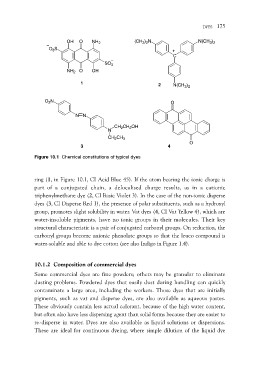
Figure 10.1 Chemical constitutions of typical dyes

ring (1, in Figure 10.1, CI Acid Blue 45). If the atom bearing the ionic charge is
part of a conjugated chain, a delocalised charge results, as in a cationic
triphenylmethane dye (2, CI Basic Violet 3). In the case of the non-ionic disperse
dyes (3, CI Disperse Red 1), the presence of polar substituents, such as a hydroxyl
group, promotes slight solubility in water. Vat dyes (4, CI Vat Yellow 4), which are
water-insoluble pigments, have no ionic groups in their molecules. Their key
structural characteristic is a pair of conjugated carbonyl groups. On reduction, the
carbonyl groups become anionic phenolate groups so that the leuco compound is
water-soluble and able to dye cotton (see also Indigo in Figure 1.4).

10.1.2 Composition of commercial dyes

Some commercial dyes are fine powders; others may be granular to eliminate
dusting problems. Powdered dyes that easily dust during handling can quickly
contaminate a large area, including the workers. Those dyes that are initially
pigments, such as vat and disperse dyes, are also available as aqueous pastes.
These obviously contain less actual colorant, because of the high water content,
but often also have less dispersing agent than solid forms because they are easier to
re-disperse in water. Dyes are also available as liquid solutions or dispersions.
These are ideal for continuous dyeing, where simple dilution of the liquid dye

