


Page 183 - Basic Principles of Textile Coloration
P. 183
172 AUXILIARY CHEMICALS FOR WET PROCESSING AND DYEING

                                                       CH3       CH3

NaO3S          CH CH2 nCH3  NaO3S      CHCH2CHCH2CHCH2CH         CH3
               CH3
                                       CH3                  CH3

       14                          15

Biodegradable                          Non-biodegradable

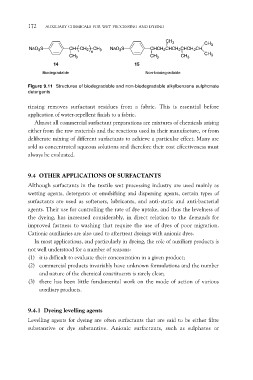
Figure 9.11 Structures of biodegradable and non-biodegradable alkylbenzene sulphonate
detergents

rinsing removes surfactant residues from a fabric. This is essential before
application of water-repellent finish to a fabric.

   Almost all commercial surfactant preparations are mixtures of chemicals arising
either from the raw materials and the reactions used in their manufacture, or from
deliberate mixing of different surfactants to achieve a particular effect. Many are
sold as concentrated aqueous solutions and therefore their cost effectiveness must
always be evaluated.

9.4 OTHER APPLICATIONS OF SURFACTANTS

Although surfactants in the textile wet processing industry are used mainly as
wetting agents, detergents or emulsifying and dispersing agents, certain types of
surfactants are used as softeners, lubricants, and anti-static and anti-bacterial
agents. Their use for controlling the rate of dye uptake, and thus the levelness of
the dyeing, has increased considerably, in direct relation to the demands for
improved fastness to washing that require the use of dyes of poor migration.
Cationic auxiliaries are also used to aftertreat dyeings with anionic dyes.

   In most applications, and particularly in dyeing, the role of auxiliary products is
not well understood for a number of reasons:
(1) it is difficult to evaluate their concentration in a given product;
(2) commercial products invariably have unknown formulations and the number

      and nature of the chemical constituents is rarely clear;
(3) there has been little fundamental work on the mode of action of various

      auxiliary products.

9.4.1 Dyeing levelling agents

Levelling agents for dyeing are often surfactants that are said to be either fibre
substantive or dye substantive. Anionic surfactants, such as sulphates or

