


Page 184 - Basic Principles of Textile Coloration
P. 184
REFERENCES 173

sulphonates, are often used to control the rate of dyeing of wool and nylon in
weakly acidic solution. Their small molecular size allows rapid penetration into
these fibres and interaction with the ammonium ion groups therein. This slows
down dye absorption by ion exchange, but eventually the more substantive dye
molecules will displace the anionic surfactant by ion exchange (Section 1.1.2,
Scheme 1.4). When acting in this manner, these auxiliary chemicals are often
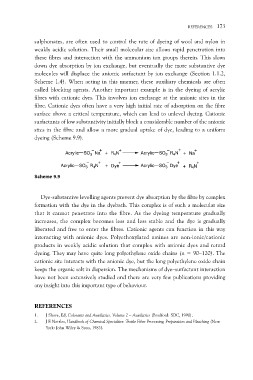
called blocking agents. Another important example is in the dyeing of acrylic
fibres with cationic dyes. This involves ion exchange at the anionic sites in the
fibre. Cationic dyes often have a very high initial rate of adsorption on the fibre
surface above a critical temperature, which can lead to unlevel dyeing. Cationic
surfactants of low substantivity initially block a considerable number of the anionic
sites in the fibre and allow a more gradual uptake of dye, leading to a uniform
dyeing (Scheme 9.9).

                    Acrylic SO3 Na + R4N  Acrylic SO3 R4N + Na
                 Acrylic SO3 R4N + Dye    Acrylic SO3 Dye + R4N
Scheme 9.9

   Dye-substantive levelling agents prevent dye absorption by the fibre by complex
formation with the dye in the dyebath. This complex is of such a molecular size
that it cannot penetrate into the fibre. As the dyeing temperature gradually
increases, the complex becomes less and less stable and the dye is gradually
liberated and free to enter the fibres. Cationic agents can function in this way
interacting with anionic dyes. Polyethoxylated amines are non-ionic/cationic
products in weakly acidic solution that complex with anionic dyes and retard
dyeing. They may have quite long polyethylene oxide chains (n = 90–120). The
cationic site interacts with the anionic dye, but the long polyethylene oxide chain
keeps the organic salt in dispersion. The mechanisms of dye–surfactant interaction
have not been extensively studied and there are very few publications providing
any insight into this important type of behaviour.

REFERENCES

1. J Shore, Ed, Colorants and Auxiliaries. Volume 2 – Auxiliaries (Bradford: SDC, 1990).
2. J E Nettles, Handbook of Chemical Specialties: Textile Fiber Processing, Preparation and Bleaching (New

        York: John Wiley & Sons, 1983).

