


Page 182 - Basic Principles of Textile Coloration
P. 182
SYNTHETIC SURFACTANTS 171

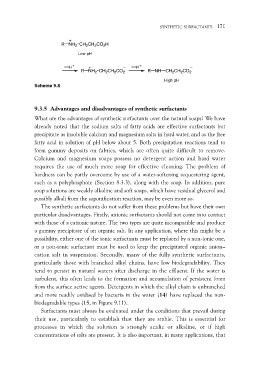
                 R NH2 CH2CH2CO2H               H+
                                 Low pH                R NH CH2CH2CO2
                                                                     High pH
                          H+
                               R NH2 CH2CH2CO2

Scheme 9.8

9.3.5 Advantages and disadvantages of synthetic surfactants

What are the advantages of synthetic surfactants over the natural soaps? We have
already noted that the sodium salts of fatty acids are effective surfactants but
precipitate as insoluble calcium and magnesium salts in hard water, and as the free
fatty acid in solution of pH below about 5. Both precipitation reactions tend to
form gummy deposits on fabrics, which are often quite difficult to remove.
Calcium and magnesium soaps possess no detergent action and hard water
requires the use of much more soap for effective cleaning. The problem of
hardness can be partly overcome by use of a water-softening sequestering agent,
such as a polyphosphate (Section 8.3.3), along with the soap. In addition, pure
soap solutions are weakly alkaline and soft soaps, which have residual glycerol and
possibly alkali from the saponification reaction, may be even more so.

   The synthetic surfactants do not suffer from these problems but have their own
particular disadvantages. Firstly, anionic surfactants should not come into contact
with those of a cationic nature. The two types are quite incompatible and produce
a gummy precipitate of an organic salt. In any application, where this might be a
possibility, either one of the ionic surfactants must be replaced by a non-ionic one,
or a non-ionic surfactant must be used to keep the precipitated organic anion–
cation salt in suspension. Secondly, many of the fully synthetic surfactants,
particularly those with branched alkyl chains, have low biodegradability. They
tend to persist in natural waters after discharge in the effluent. If the water is
turbulent, this often leads to the formation and accumulation of persistent foam
from the surface active agents. Detergents in which the alkyl chain is unbranched
and more readily oxidised by bacteria in the water (14) have replaced the non-
biodegradable types (15, in Figure 9.11).

   Surfactants must always be evaluated under the conditions that prevail during
their use, particularly to establish that they are stable. This is essential for
processes in which the solution is strongly acidic or alkaline, or if high
concentrations of salts are present. It is also important, in many applications, that

