


Page 224 - Basic Principles of Textile Coloration
P. 224
AGGREGATION OF DYES 213

       3
       2

log D  1
       0

       –1

       _2
       _0.5
             0  0.5             1      1.5     2 2.5

                             log t

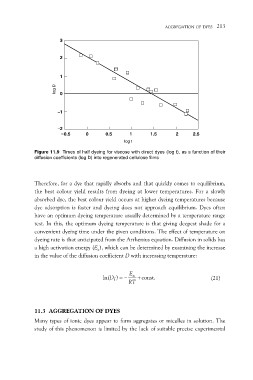
Figure 11.9 Times of half dyeing for viscose with direct dyes (log t), as a function of their
diffusion coefficients (log D) into regenerated cellulose films

Therefore, for a dye that rapidly absorbs and that quickly comes to equilibrium,
the best colour yield results from dyeing at lower temperatures. For a slowly
absorbed dye, the best colour yield occurs at higher dyeing temperatures because
dye adsorption is faster and dyeing does not approach equilibrium. Dyes often
have an optimum dyeing temperature usually determined by a temperature range
test. In this, the optimum dyeing temperature is that giving deepest shade for a
convenient dyeing time under the given conditions. The effect of temperature on
dyeing rate is that anticipated from the Arrhenius equation. Diffusion in solids has
a high activation energy (Ea), which can be determined by examining the increase
in the value of the diffusion coefficient D with increasing temperature:

                ln(Df  )  =  -  Ea  +  const.         (21)
                                RT

11.3 AGGREGATION OF DYES

Many types of ionic dyes appear to form aggregates or micelles in solution. The
study of this phenomenon is limited by the lack of suitable precise experimental

