


Page 221 - Basic Principles of Textile Coloration
P. 221
210 DYEING THEORY
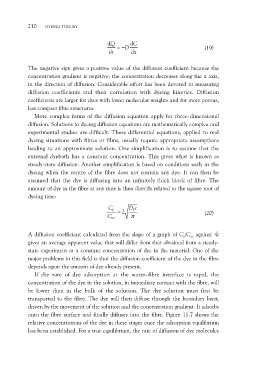
dQ = -D dC (19)
dt dx
The negative sign gives a positive value of the diffusion coefficient because the
concentration gradient is negative; the concentration decreases along the x axis,
in the direction of diffusion. Considerable effort has been devoted to measuring
diffusion coefficients and their correlation with dyeing kinetics. Diffusion
coefficients are larger for dyes with lower molecular weights and for more porous,
less compact fibre structures.
More complex forms of the diffusion equation apply for three-dimensional
diffusion. Solutions to dyeing diffusion equations are mathematically complex and
experimental studies are difficult. These differential equations, applied to real
dyeing situations with fibres or films, usually require appropriate assumptions
leading to an approximate solution. One simplification is to assume that the
external dyebath has a constant concentration. This gives what is known as
steady-state diffusion. Another simplification is based on conditions early in the
dyeing when the centre of the fibre does not contain any dye. It can then be
assumed that the dye is diffusing into an infinitely thick block of fibre. The
amount of dye in the fibre at any time is then directly related to the square root of
dyeing time:
Ct = 2 Df t (20)
C p
A diffusion coefficient calculated from the slope of a graph of Ct/C¥ against Öt
gives an average apparent value that will differ from that obtained from a steady-
state experiment at a constant concentration of dye in the material. One of the
major problems in this field is that the diffusion coefficient of the dye in the fibre
depends upon the amount of dye already present.
If the rate of dye adsorption at the water–fibre interface is rapid, the
concentration of the dye in the solution, in immediate contact with the fibre, will
be lower than in the bulk of the solution. The dye solution must first be
transported to the fibre. The dye will then diffuse through the boundary layer,
driven by the movement of the solution and the concentration gradient. It adsorbs
onto the fibre surface and finally diffuses into the fibre. Figure 11.7 shows the
relative concentrations of the dye in these stages once the adsorption equilibrium
has been established. For a true equilibrium, the rate of diffusion of dye molecules

