


Page 220 - Basic Principles of Textile Coloration
P. 220
DYEING KINETICS 209
Exhaustion isotherms can be described by different empirical equations. One or
other of the following two equations sometimes gives a reasonable description of
the dyebath exhaustion during the dyeing process.
Et = 1 - e-kt or 1 - 1 = kt (18)
E E - Et E
The symbol Et represents the exhaustion at time t, and E¥ represents the value at
equilibrium (infinite time). The symbol k is the kinetic or rate constant. These two
equations, however, describe quite different dyeing behaviour.
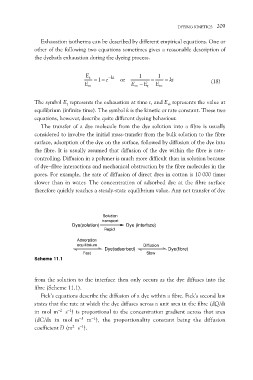
The transfer of a dye molecule from the dye solution into a fibre is usually
considered to involve the initial mass-transfer from the bulk solution to the fibre
surface, adsorption of the dye on the surface, followed by diffusion of the dye into
the fibre. It is usually assumed that diffusion of the dye within the fibre is rate-
controlling. Diffusion in a polymer is much more difficult than in solution because
of dye–fibre interactions and mechanical obstruction by the fibre molecules in the
pores. For example, the rate of diffusion of direct dyes in cotton is 10 000 times
slower than in water. The concentration of adsorbed dye at the fibre surface
therefore quickly reaches a steady-state equilibrium value. Any net transfer of dye
Solution Dye (interface)
transport
Dye(solution)
Rapid
Adsorption Dye(adsorbed) Diffusion Dye(fibre)
equilibrium Slow
Fast
Scheme 11.1
from the solution to the interface then only occurs as the dye diffuses into the
fibre (Scheme 11.1).
Fick’s equations describe the diffusion of a dye within a fibre. Fick’s second law
states that the rate at which the dye diffuses across a unit area in the fibre (dQ/dt
in mol m–2 s–1) is proportional to the concentration gradient across that area
(dC/dx in mol m–3 m–1), the proportionality constant being the diffusion
coefficient D (m2 s–1).

