


Page 25 - Basic Principles of Textile Coloration
P. 25
14 AN INTRODUCTION TO TEXTILES, DYES AND DYEING

electromagnetic waves. All types of electromagnetic radiation are characterised by
their wavelength (l) (the distance between the wave crests), or by the frequency
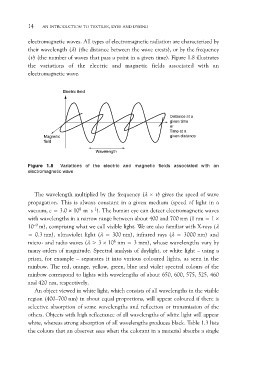
(n) (the number of waves that pass a point in a given time). Figure 1.8 illustrates
the variations of the electric and magnetic fields associated with an
electromagnetic wave.

                          Electric field

Magnetic              Distance at a
field                 given time
                      or
                      Time at a
                      given distance

          Wavelength

Figure 1.8 Variations of the electric and magnetic fields associated with an
electromagnetic wave

   The wavelength multiplied by the frequency (l ´ n) gives the speed of wave
propagation. This is always constant in a given medium (speed of light in a
vacuum, c = 3.0 ´ 108 m s–1). The human eye can detect electromagnetic waves
with wavelengths in a narrow range between about 400 and 700 nm (1 nm = 1 ´
10–9 m), comprising what we call visible light. We are also familiar with X-rays (l
= 0.3 nm), ultraviolet light (l = 300 nm), infrared rays (l = 3000 nm) and
micro- and radio waves (l > 3 ´ 106 nm = 3 mm), whose wavelengths vary by
many orders of magnitude. Spectral analysis of daylight, or white light – using a
prism, for example – separates it into various coloured lights, as seen in the
rainbow. The red, orange, yellow, green, blue and violet spectral colours of the
rainbow correspond to lights with wavelengths of about 650, 600, 575, 525, 460
and 420 nm, respectively.

   An object viewed in white light, which consists of all wavelengths in the visible
region (400–700 nm) in about equal proportions, will appear coloured if there is
selective absorption of some wavelengths and reflection or transmission of the
others. Objects with high reflectance of all wavelengths of white light will appear
white, whereas strong absorption of all wavelengths produces black. Table 1.3 lists
the colours that an observer sees when the colorant in a material absorbs a single

