


Page 23 - Basic Principles of Textile Coloration
P. 23
12 AN INTRODUCTION TO TEXTILES, DYES AND DYEING

impurities, lubricating oils (added to aid carding, spinning or knitting) and size
(used to reinforce the warp yarns in weaving). Bleaching eliminates any coloured
impurities and is often necessary for white goods containing natural fibres, and
before dyeing pale, bright shades. This stage of production is called preparation. Its
objective is to clean the material before dyeing and finishing so that it wets easily
and uniformly absorbs solutions of chemicals and dyes. Poor quality preparation,
particularly when it is uneven, is a major cause of faulty dyeings.

   The final stage in the manufacture of a textile is finishing. This involves
treatments to improve the appearance or performance of the material. It might
consist of a simple mechanical process such as calendering (to give the fabric a
flat, compact surface) or napping (to break fibres and raise the ends forming a
pile). Modification of the functional characteristics of a fabric often involves
chemical finishing. The processes range from the simple application of a softening
agent to improve the material’s handle and reduce static electricity, to those that
render cotton fabric flame resistant or crease resistant. Most chemical finishing is
for fabrics of natural fibres, particularly for those containing cotton. This satisfies
consumer demand for cotton materials having the easy-care characteristics
associated with fabrics made from synthetic fibres. Many finishing processes,
particularly those involving chemicals, can modify both the colour and the fastness
properties of a dyed fabric, and these effects must therefore be known in advance.

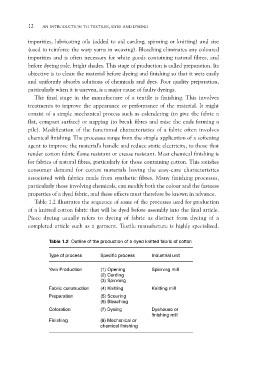
   Table 1.2 illustrates the sequence of some of the processes used for production
of a knitted cotton fabric that will be dyed before assembly into the final article.
Piece dyeing usually refers to dyeing of fabric as distinct from dyeing of a
completed article such as a garment. Textile manufacture is highly specialised.

Table 1.2 Outline of the production of a dyed knitted fabric of cotton

Type of process      Specific process            Industrial unit

Yarn Production      (1) Opening                 Spinning mill
                     (2) Carding
Fabric construction  (3) Spinning                Knitting mill
Preparation
Coloration           (4) Knitting                Dyehouse or
Finishing                                        finishing mill
                     (5) Scouring
                     (6) Bleaching

                     (7) Dyeing

                     (8) Mechanical or
                     chemical finishing

