


Page 26 - Basic Principles of Textile Coloration
P. 26
COLOUR, DYES AND DYEING 15

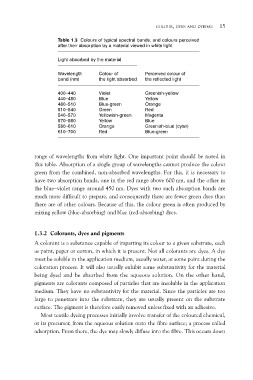
Table 1.3 Colours of typical spectral bands, and colours perceived
after their absorption by a material viewed in white light

Light absorbed by the material

Wavelength  Colour of           Perceived colour of
band (nm)
            the light absorbed the reflected light

400–440     Violet              Greenish-yellow
440–480     Blue                Yellow
480–510     Blue-green          Orange
510–540     Green               Red
540–570     Yellowish-green     Magenta
570–580     Yellow              Blue
580–610     Orange              Greenish-blue (cyan)
610–700     Red                 Blue-green

range of wavelengths from white light. One important point should be noted in
this table. Absorption of a single group of wavelengths cannot produce the colour
green from the combined, non-absorbed wavelengths. For this, it is necessary to
have two absorption bands, one in the red range above 600 nm, and the other in
the blue–violet range around 450 nm. Dyes with two such absorption bands are
much more difficult to prepare, and consequently there are fewer green dyes than
there are of other colours. Because of this, the colour green is often produced by
mixing yellow (blue-absorbing) and blue (red-absorbing) dyes.

1.3.2 Colorants, dyes and pigments

A colorant is a substance capable of imparting its colour to a given substrate, such
as paint, paper or cotton, in which it is present. Not all colorants are dyes. A dye
must be soluble in the application medium, usually water, at some point during the
coloration process. It will also usually exhibit some substantivity for the material
being dyed and be absorbed from the aqueous solution. On the other hand,
pigments are colorants composed of particles that are insoluble in the application
medium. They have no substantivity for the material. Since the particles are too
large to penetrate into the substrate, they are usually present on the substrate
surface. The pigment is therefore easily removed unless fixed with an adhesive.

   Most textile dyeing processes initially involve transfer of the coloured chemical,
or its precursor, from the aqueous solution onto the fibre surface; a process called
adsorption. From there, the dye may slowly diffuse into the fibre. This occurs down

