


Page 21 - Basic Principles of Textile Coloration
P. 21
10 AN INTRODUCTION TO TEXTILES, DYES AND DYEING

manufacturer, and the merger of DyStar and BASF is imminent. The more recent
history of the dyestuff industry is described in a series of four articles by Park and
Shore [1].

1.2 MODERN TEXTILES

1.2.1 The classification of fibres
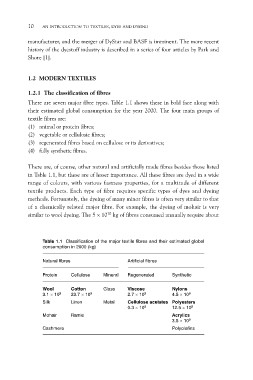
There are seven major fibre types. Table 1.1 shows these in bold face along with
their estimated global consumption for the year 2000. The four main groups of
textile fibres are:
(1) animal or protein fibres;
(2) vegetable or cellulosic fibres;
(3) regenerated fibres based on cellulose or its derivatives;
(4) fully synthetic fibres.

There are, of course, other natural and artificially made fibres besides those listed
in Table 1.1, but these are of lesser importance. All these fibres are dyed in a wide
range of colours, with various fastness properties, for a multitude of different
textile products. Each type of fibre requires specific types of dyes and dyeing
methods. Fortunately, the dyeing of many minor fibres is often very similar to that
of a chemically related major fibre. For example, the dyeing of mohair is very
similar to wool dyeing. The 5 ´ 1010 kg of fibres consumed annually require about

Table 1.1 Classification of the major textile fibres and their estimated global
consumption in 2000 (kg)

Natural fibres                     Artificial fibres

Protein         Cellulose   Mineral Regenerated       Synthetic

Wool            Cotton      Glass  Viscose            Nylons
3.1 ´ 109       23.7 ´ 109  Metal  2.7 ´ 109          4.5 ´ 109

Silk            Linen              Cellulose acetates Polyesters

                                   0.3 ´ 109          12.5 ´ 109

Mohair          Ramie                                 Acrylics
                                                      3.5 ´ 109

Cashmere                                              Polyolefins

