


Page 274 - Basic Principles of Textile Coloration
P. 274
MORDANT DYES FOR WOOL 263

   The significant increase in fastness to wet treatments that occurs on after-
chroming the initial acid dye may be a consequence of the dye being chemically
bonded to the fibre. This would involve carboxylate and amino groups in the wool
acting as ligands and forming coordinate bonds to the metal in a 1:1 dye–metal
complex. This has never been confirmed and it could not occur with 2:1 dye–
metal complexes since all the coordination sites are full. The improved fastness to
washing is therefore most likely due to the reduced solubility and diffusion of the
complex because of the increase in molecular size on complexation, particularly for
the formation of 2:1 dye–metal complexes.

   The major problems with chrome dyes for wool are the long treatment time at
the boil, which results in damage to the wool fibres, and the residual chromium in
the dyehouse effluent. Dyeing at 80–90 °C, with added acetic acid, and after-
chroming with sodium dichromate at around 90 °C, in the presence of formic acid
and sodium thiosulphate, avoids detrimental effects on the quality of the wool
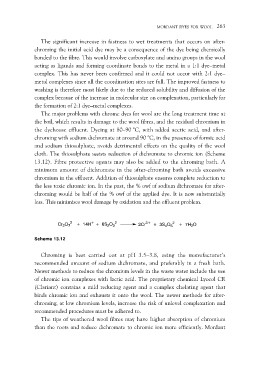
cloth. The thiosulphate assists reduction of dichromate to chromic ion (Scheme
13.12). Fibre protective agents may also be added to the chroming bath. A
minimum amount of dichromate in the after-chroming bath avoids excessive
chromium in the effluent. Addition of thiosulphate ensures complete reduction to
the less toxic chromic ion. In the past, the % owf of sodium dichromate for after-
chroming would be half of the % owf of the applied dye. It is now substantially
less. This minimises wool damage by oxidation and the effluent problem.

               Cr2O72– + 14H+ + 6S2O32–  2Cr3+ + 3S4O62– + 7H2O
Scheme 13.12

   Chroming is best carried out at pH 3.5–3.8, using the manufacturer’s
recommended amount of sodium dichromate, and preferably in a fresh bath.
Newer methods to reduce the chromium levels in the waste water include the use
of chromic ion complexes with lactic acid. The proprietary chemical Lyocol CR
(Clariant) contains a mild reducing agent and a complex chelating agent that
binds chromic ion and exhausts it onto the wool. The newer methods for after-
chroming, at low chromium levels, increase the risk of unlevel complexation and
recommended procedures must be adhered to.

   The tips of weathered wool fibres may have higher absorption of chromium
than the roots and reduce dichromate to chromic ion more efficiently. Mordant

