


Page 273 - Basic Principles of Textile Coloration
P. 273
262 ACID, PRE-METALLISED AND MORDANT DYES

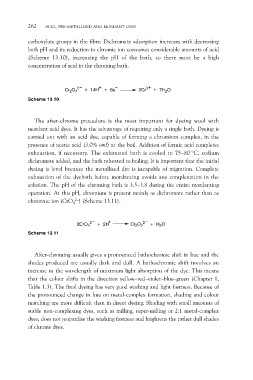
carboxylate groups in the fibre. Dichromate adsorption increases with decreasing
bath pH and its reduction to chromic ion consumes considerable amounts of acid
(Scheme 13.10), increasing the pH of the bath, so there must be a high
concentration of acid in the chroming bath.

                        Cr2O72 + 14H + 6e  2Cr3 + 7H2O
Scheme 13.10

   The after-chrome procedure is the most important for dyeing wool with
mordant acid dyes. It has the advantage of requiring only a single bath. Dyeing is
carried out with an acid dye, capable of forming a chromium complex, in the
presence of acetic acid (3.0% owf) at the boil. Addition of formic acid completes
exhaustion, if necessary. The exhausted bath is cooled to 75–80 °C, sodium
dichromate added, and the bath reheated to boiling. It is important that the initial
dyeing is level because the metallised dye is incapable of migration. Complete
exhaustion of the dyebath before mordanting avoids any complexation in the
solution. The pH of the chroming bath is 3.5–3.8 during the entire mordanting
operation. At this pH, chromium is present mainly as dichromate rather than as
chromate ion (CrO42–) (Scheme 13.11).

              2CrO42 + 2H                  Cr2O72 + H2O

Scheme 13.11

   After-chroming usually gives a pronounced bathochromic shift in hue and the
shades produced are usually dark and dull. A bathochromic shift involves an
increase in the wavelength of maximum light absorption of the dye. This means
that the colour shifts in the direction yellow–red–violet–blue–green (Chapter 1,
Table 1.3). The final dyeing has very good washing and light fastness. Because of
the pronounced change in hue on metal-complex formation, shading and colour
matching are more difficult than in direct dyeing. Shading with small amounts of
stable non-complexing dyes, such as milling, super-milling or 2:1 metal-complex
dyes, does not jeopardise the washing fastness and brightens the rather dull shades
of chrome dyes.

