


Page 269 - Basic Principles of Textile Coloration
P. 269
258 ACID, PRE-METALLISED AND MORDANT DYES

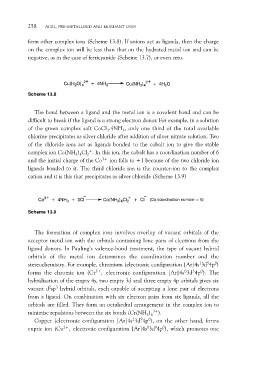
form other complex ions (Scheme 13.8). If anions act as ligands, then the charge
on the complex ion will be less than that on the hydrated metal ion and can be
negative, as in the case of ferricyanide (Scheme 13.7), or even zero.

             Cu(H2O)42 + 4NH3  Cu(NH3)42 + 4H2O

Scheme 13.8

   The bond between a ligand and the metal ion is a covalent bond and can be

difficult to break if the ligand is a strong electron donor. For example, in a solution
of the green complex salt CoCl3.4NH3, only one third of the total available
chlorine precipitates as silver chloride after addition of silver nitrate solution. Two

of the chloride ions act as ligands bonded to the cobalt ion to give the stable
complex ion Co(NH3)4Cl2+. In this ion, the cobalt has a coordination number of 6
and the initial charge of the Co3+ ion falls to +1 because of the two chloride ion

ligands bonded to it. The third chloride ion is the counter-ion to the complex
cation and it is this that precipitates as silver chloride (Scheme 13.9)

      Co3 + 4NH3 + 3Cl  Co(NH3)4Cl2 + Cl (Co coordination number = 6)
Scheme 13.9

   The formation of complex ions involves overlap of vacant orbitals of the
acceptor metal ion with the orbitals containing lone pairs of electrons from the
ligand donors. In Pauling’s valence-bond treatment, the type of vacant hybrid
orbitals of the metal ion determines the coordination number and the
stereochemistry. For example, chromium (electronic configuration [Ar]4s13d54p0)
forms the chromic ion (Cr3+, electronic configuration [Ar]4s03d34p0). The
hybridisation of the empty 4s, two empty 3d and three empty 4p orbitals gives six
vacant d2sp3 hybrid orbitals, each capable of accepting a lone pair of electrons
from a ligand. On combination with six electron pairs from six ligands, all the
orbitals are filled. They form an octahedral arrangement in the complex ion to
minimise repulsions between the six bonds (Cr(NH3)63+).

   Copper (electronic configuration [Ar]4s23d94p0), on the other hand, forms
cupric ion (Cu2+, electronic configuration [Ar]4s03d94p0), which promotes one

