


Page 344 - Basic Principles of Textile Coloration
P. 344
REACTIVE DYES FOR COTTON 333

   The dyeings had very good fastness to washing. The only way the fixed dye can
bleed from the cotton is after hydrolysis of the covalent bond between the dye and
the cellulose. This requires conditions more forceful than those met with in
ordinary washing in hot water. Within about five years of this important
development, all the major dyestuff manufacturers were marketing reactive dyes
for cotton, and also for wool. Reactive dyes, particularly those used for dyeing
cotton, have become one of the major classes of dye because of their good washing
fastness, their bright shades and their versatile batch and continuous dyeing
methods.

16.2 REACTIVE DYES FOR COTTON [1]

16.2.1 Structures of reactive dyes for cotton

The molecular structures of reactive dyes resemble those of acid and simple direct
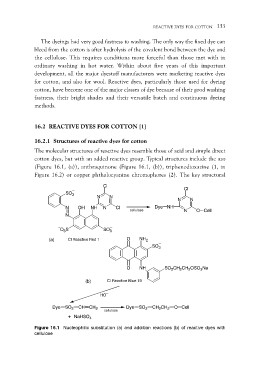
cotton dyes, but with an added reactive group. Typical structures include the azo
(Figure 16.1, (a)), anthraquinone (Figure 16.1, (b)), triphenodioxazine (1, in
Figure 16.2) or copper phthalocyanine chromophores (2). The key structural

                         Cl                            Cl
SO3 N N
                                                       NN
N OH NH N Cl
N                                 cellulose  Dye NH    N O Cell

O3S                    SO3

(a) CI Reactive Red 1             O NH2
                                                  SO3

                                O NH                   SO2CH2CH2OSO3Na
     (b) CI Reactive Blue 19

                       HO

Dye SO2 CH CH2         cellulose  Dye SO2 CH2CH2 O Cell
          + NaHSO4

Figure 16.1 Nucleophilic substitution (a) and addition reactions (b) of reactive dyes with
cellulose

