


Page 346 - Basic Principles of Textile Coloration
P. 346
REACTIVE DYES FOR COTTON 335

fibre (Scheme 16.2). In addition, the dye–fibre bond, once formed, should have
adequate stability to withstand repeated washing. Other factors involved are the
ease of manufacture, the dye stability during storage and the cost of the final
reactive dye.

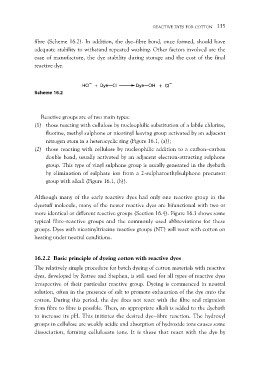
             HO + Dye Cl  Dye OH + Cl

Scheme 16.2

   Reactive groups are of two main types:
(1) those reacting with cellulose by nucleophilic substitution of a labile chlorine,

      fluorine, methyl sulphone or nicotinyl leaving group activated by an adjacent
      nitrogen atom in a heterocyclic ring (Figure 16.1, (a));
(2) those reacting with cellulose by nucleophilic addition to a carbon–carbon
      double bond, usually activated by an adjacent electron-attracting sulphone
      group. This type of vinyl sulphone group is usually generated in the dyebath
      by elimination of sulphate ion from a 2-sulphatoethylsulphone precursor
      group with alkali (Figure 16.1, (b)).

Although many of the early reactive dyes had only one reactive group in the
dyestuff molecule, many of the newer reactive dyes are bifunctional with two or
more identical or different reactive groups (Section 16.4). Figure 16.3 shows some
typical fibre-reactive groups and the commonly used abbreviations for these
groups. Dyes with nicotinyltriazine reactive groups (NT) will react with cotton on
heating under neutral conditions.

16.2.2 Basic principle of dyeing cotton with reactive dyes
The relatively simple procedure for batch dyeing of cotton materials with reactive
dyes, developed by Rattee and Stephen, is still used for all types of reactive dyes
irrespective of their particular reactive group. Dyeing is commenced in neutral
solution, often in the presence of salt to promote exhaustion of the dye onto the
cotton. During this period, the dye does not react with the fibre and migration
from fibre to fibre is possible. Then, an appropriate alkali is added to the dyebath
to increase its pH. This initiates the desired dye–fibre reaction. The hydroxyl
groups in cellulose are weakly acidic and absorption of hydroxide ions causes some
dissociation, forming cellulosate ions. It is these that react with the dye by

