


Page 51 - Basic Principles of Textile Coloration
P. 51
40 FIBROUS POLYMERS
The molecular weight of a polymer may be defined in various ways. The usual
molecular weight is the number average molecular weight (Eqn 1). This is the
mass of an Avogadro’s number of molecules (6.023 ´ 1023). Molecular weight
determinations based on end group analysis or the colligative properties of
polymers give this type of molecular weight, from which the average value of the
DP is obtained. Polymer molecular weights may also be defined by a weight
average (Eqn 2). This type of molecular weight is obtained from measurements of
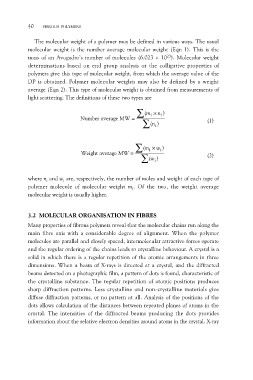
light scattering. The definitions of these two types are
ÊÊNumber average MW =(mi ni ) (1)
(ni )
ÊÊWeight average MW =(mi wi ) (2)
(wi )
where ni and wi are, respectively, the number of moles and weight of each type of
polymer molecule of molecular weight mi. Of the two, the weight average
molecular weight is usually higher.
3.2 MOLECULAR ORGANISATION IN FIBRES
Many properties of fibrous polymers reveal that the molecular chains run along the
main fibre axis with a considerable degree of alignment. When the polymer
molecules are parallel and closely spaced, intermolecular attractive forces operate
and the regular ordering of the chains leads to crystalline behaviour. A crystal is a
solid in which there is a regular repetition of the atomic arrangements in three
dimensions. When a beam of X-rays is directed at a crystal, and the diffracted
beams detected on a photographic film, a pattern of dots is found, characteristic of
the crystalline substance. The regular repetition of atomic positions produces
sharp diffraction patterns. Less crystalline and non-crystalline materials give
diffuse diffraction patterns, or no pattern at all. Analysis of the positions of the
dots allows calculation of the distances between repeated planes of atoms in the
crystal. The intensities of the diffracted beams producing the dots provides
information about the relative electron densities around atoms in the crystal. X-ray

