


Page 70 - Basic Principles of Textile Coloration
P. 70
POLYESTERS 59

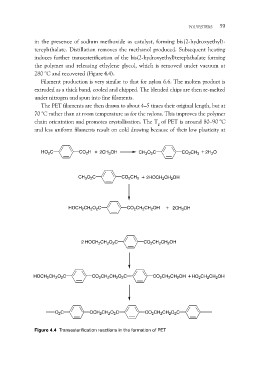
in the presence of sodium methoxide as catalyst, forming bis(2-hydroxyethyl)-
terephthalate. Distillation removes the methanol produced. Subsequent heating
induces further transesterification of the bis(2-hydroxyethyl)terephthalate forming
the polymer and releasing ethylene glycol, which is removed under vacuum at
280 °C and recovered (Figure 4.4).

   Filament production is very similar to that for nylon 6.6. The molten product is
extruded as a thick band, cooled and chipped. The blended chips are then re-melted
under nitrogen and spun into fine filaments.

   The PET filaments are then drawn to about 4–5 times their original length, but at
70 °C rather than at room temperature as for the nylons. This improves the polymer
chain orientation and promotes crystallisation. The Tg of PET is around 80–90 °C
and less uniform filaments result on cold drawing because of their low plasticity at

HO2C         CO2H + 2CH3OH  CH3O2C                                CO2CH3 + 2H2O

             CH3O2C         CO2CH3 + 2HOCH2CH2OH

             HOCH2CH2O2C    CO2CH2CH2OH + 2CH3OH

             2 HOCH2CH2O2C  CO2CH2CH2OH

HOCH2CH2O2C  CO2CH2CH2O2C   CO2CH2CH2OH +HO2CH2CH2OH

      O2C    OCH2CH2O2C     CO2CH2CH2O2C

Figure 4.4 Transesterification reactions in the formation of PET

