


Page 74 - Basic Principles of Textile Coloration
P. 74
POLYESTERS 63

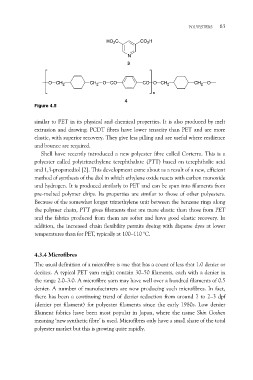
                HO2C                      CO2H

                      N
                      3

         O CH2  CH2 O CO                  CO O CH2   CH2 O
Figure 4.5                             4
                                                  n

similar to PET in its physical and chemical properties. It is also produced by melt
extrusion and drawing. PCDT fibres have lower tenacity than PET and are more
elastic, with superior recovery. They give less pilling and are useful where resilience
and bounce are required.

   Shell have recently introduced a new polyester fibre called Corterra. This is a
polyester called polytrimethylene terephthalate (PTT) based on terephthalic acid
and 1,3-propanediol [2]. This development came about as a result of a new, efficient
method of synthesis of the diol in which ethylene oxide reacts with carbon monoxide
and hydrogen. It is produced similarly to PET and can be spun into filaments from
pre-melted polymer chips. Its properties are similar to those of other polyesters.
Because of the somewhat longer trimethylene unit between the benzene rings along
the polymer chain, PTT gives filaments that are more elastic than those from PET
and the fabrics produced from them are softer and have good elastic recovery. In
addition, the increased chain flexibility permits dyeing with disperse dyes at lower
temperatures than for PET, typically at 100–110 °C.

4.3.4 Microfibres

The usual definition of a microfibre is one that has a count of less that 1.0 denier or
decitex. A typical PET yarn might contain 30–50 filaments, each with a denier in
the range 2.0–3.0. A microfibre yarn may have well over a hundred filaments of 0.5
denier. A number of manufacturers are now producing such microfibres. In fact,
there has been a continuing trend of denier reduction from around 7 to 2–3 dpf
(denier per filament) for polyester filaments since the early 1980s. Low denier
filament fabrics have been most popular in Japan, where the name Shin Goshen
meaning ‘new synthetic fibre’ is used. Microfibres only have a small share of the total
polyester market but this is growing quite rapidly.

