


Page 77 - Basic Principles of Textile Coloration
P. 77
66 SYNTHETIC FIBRES

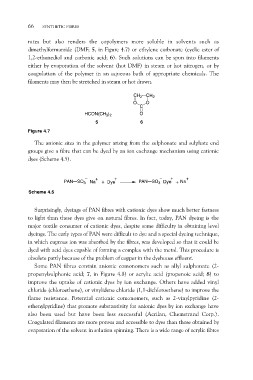
rates but also renders the copolymers more soluble in solvents such as
dimethylformamide (DMF; 5, in Figure 4.7) or ethylene carbonate (cyclic ester of
1,2-ethanediol and carbonic acid; 6). Such solutions can be spun into filaments
either by evaporation of the solvent (hot DMF) in steam or hot nitrogen, or by
coagulation of the polymer in an aqueous bath of appropriate chemicals. The
filaments may then be stretched in steam or hot drawn.

                     HCON(CH3)2  CH2 CH2
                            5    OO

                                     C
                                     O

                                     6

Figure 4.7

   The anionic sites in the polymer arising from the sulphonate and sulphate end
groups give a fibre that can be dyed by an ion exchange mechanism using cationic
dyes (Scheme 4.5).

            PAN SO3 Na + Dye     PAN SO3 Dye + Na

Scheme 4.5

   Surprisingly, dyeings of PAN fibres with cationic dyes show much better fastness
to light than these dyes give on natural fibres. In fact, today, PAN dyeing is the
major textile consumer of cationic dyes, despite some difficulty in obtaining level
dyeings. The early types of PAN were difficult to dye and a special dyeing technique,
in which cuprous ion was absorbed by the fibres, was developed so that it could be
dyed with acid dyes capable of forming a complex with the metal. This procedure is
obsolete partly because of the problem of copper in the dyehouse effluent.

   Some PAN fibres contain anionic comonomers such as allyl sulphonate (2-
propenylsulphonic acid; 7, in Figure 4.8) or acrylic acid (propenoic acid; 8) to
improve the uptake of cationic dyes by ion exchange. Others have added vinyl
chloride (chloroethene), or vinylidene chloride (1,1-dichloroethene) to improve the
flame resistance. Potential cationic comonomers, such as 2-vinylpyridine (2-
ethenylpyridine) that promote substantivity for anionic dyes by ion exchange have
also been used but have been less successful (Acrilan, Chemstrand Corp.).
Coagulated filaments are more porous and accessible to dyes than those obtained by
evaporation of the solvent in solution spinning. There is a wide range of acrylic fibres

