


Page 330 - Elementary_Linear_Algebra_with_Applications_Anton__9_edition
P. 330
Converting between Forms

The Newton form offers other advantages, but now we turn to the following question: If we have the coefficients of the
interpolating polynomial in Newton form, what are the coefficients in the standard form? For example, if we know the coefficients
in
because we have solved 4 in order to avoid having to solve the more complicated Vandermonde system 1, how can we get the
coefficients in 2,

from , , , ? Expanding the products in 3 gives

so

This can be expressed as

                                                                                                                                                          (5)

This is an important result! Solving the Vandermonde system 1 by Gaussian elimination would require us to form an matrix
that might have no nonzero entries and then to solve it using a number of arithmetic operations that grows in proportion to for
large n. But solving the lower triangular system 4 requires an amount of work that grows in proportion to for large n, and using
5 to compute the coefficients , , , also requires an amount of work that grows in proportion to for large n. Hence, for
large n, the latter approach is an order of magnitude more efficient. The two-step procedure of solving 4 and then using the linear
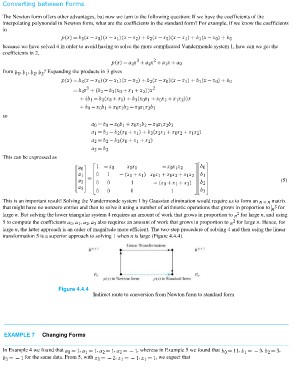
transformation 5 is a superior approach to solving 1 when n is large (Figure 4.4.4).

Figure 4.4.4
                   Indirect route to conversion from Newton form to standard form

EXAMPLE 7 Changing Forms                     ,  , whereas in Example 5 we found that  ,  ,,
                                             ,  , , we expect that
In Example 4 we found that , ,
            for the same data. From 5, with

