


Page 894 - Elementary_Linear_Algebra_with_Applications_Anton__9_edition
P. 894
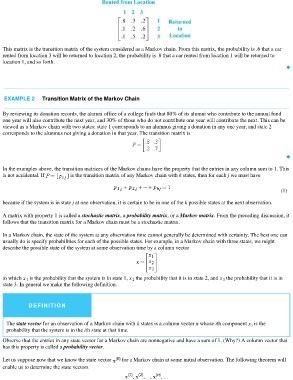
This matrix is the transition matrix of the system considered as a Markov chain. From this matrix, the probability is .6 that a car
rented from location 3 will be returned to location 2, the probability is .8 that a car rented from location 1 will be returned to
location 1, and so forth.

EXAMPLE 2 Transition Matrix of the Markov Chain

By reviewing its donation records, the alumni office of a college finds that 80% of its alumni who contribute to the annual fund
one year will also contribute the next year, and 30% of those who do not contribute one year will contribute the next. This can be
viewed as a Markov chain with two states: state 1 corresponds to an alumnus giving a donation in any one year, and state 2
corresponds to the alumnus not giving a donation in that year. The transition matrix is

In the examples above, the transition matrices of the Markov chains have the property that the entries in any column sum to 1. This

is not accidental. If  is the transition matrix of any Markov chain with k states, then for each j we must have

                                                                                                                                                          (1)

because if the system is in state j at one observation, it is certain to be in one of the k possible states at the next observation.

A matrix with property 1 is called a stochastic matrix, a probability matrix, or a Markov matrix. From the preceding discussion, it
follows that the transition matrix for a Markov chain must be a stochastic matrix.

In a Markov chain, the state of the system at any observation time cannot generally be determined with certainty. The best one can
usually do is specify probabilities for each of the possible states. For example, in a Markov chain with three states, we might
describe the possible state of the system at some observation time by a column vector

in which is the probability that the system is in state 1, the probability that it is in state 2, and the probability that it is in
state 3. In general we make the following definition.

              DEFINITION

  The state vector for an observation of a Markov chain with k states is a column vector x whose ith component is the
  probability that the system is in the ith state at that time.
Observe that the entries in any state vector for a Markov chain are nonnegative and have a sum of 1. (Why?) A column vector that
has this property is called a probability vector.

Let us suppose now that we know the state vector for a Markov chain at some initial observation. The following theorem will
enable us to determine the state vectors

