Page 104 - C:\Users\trainee\AppData\Local\Temp\msoEAA3.tmp
P. 104
Fundamentals of Stress and Vibration                1. Mathematics for Structural mechanics
                 [A Practical guide for aspiring Designers / Analysts]
                ͳǤͶǤʹ  ‡”‹˜ƒ–‹˜‡ –‘ ϐ‹†  ƒš ƒ†  ‹ ‘ˆ ƒ ˆ—…–‹‘

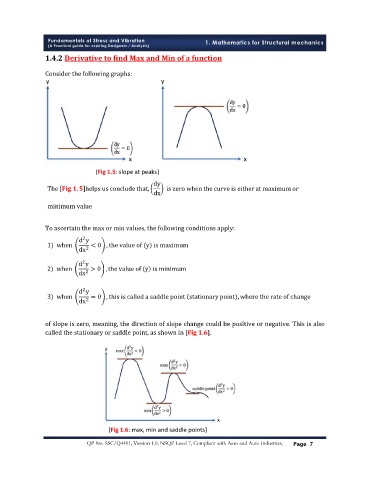
                 ‘•‹†‡” –Ї ˆ‘ŽŽ‘™‹‰ ‰”ƒ’Š•ǣ


                                 [Fig 1.5: slope at peaks]
                                                    dy
                 The           .    helps us conclude that,       is zero when the curve is either at maximum or
                                                    dx

                 minimum value


                 ‘ ƒ•…‡”–ƒ‹ –Ї ƒš ‘” ‹ ˜ƒŽ—‡•ǡ –Ї ˆ‘ŽŽ‘™‹‰ …‘†‹–‹‘• ƒ’’Ž›ǣ

                            2
                           d y
                 1)  when      < 0  , the value of  y  is maximum
                           dx 2
                            2
                           d y
                 2)  when      > 0  , the value of  y  is minimum
                           dx 2
                            2
                           d y
                 3)  when      = 0  , this is called a saddle point  stationary point , where the rate of change
                           dx 2


                ‘ˆ •Ž‘’‡ ‹• œ‡”‘ǡ ‡ƒ‹‰ǡ –Ї †‹”‡…–‹‘ ‘ˆ •Ž‘’‡ …Šƒ‰‡ …‘—ކ „‡ ’‘•‹–‹˜‡ ‘” ‡‰ƒ–‹˜‡Ǥ  Š‹• ‹• ƒŽ•‘
                …ƒŽŽ‡† –Ї •–ƒ–‹‘ƒ”› ‘” •ƒ††Ž‡ ’‘‹–ǡ ƒ• •Š‘™ ‹ ȏ ‹‰ ͳǤ͸ȐǤ


                                     [Fig 1.6: max, min and saddle points]

                              QP No. SSC/Q4401, Version 1.0, NSQF Level 7, Compliant with Aero and Auto Industries,   Page 7
   99   100   101   102   103   104   105   106   107   108   109