


Page 125 - C:\Users\trainee\AppData\Local\Temp\msoEAA3.tmp
P. 125
Fundamentals of Stress and Vibration
[A Practical guide for aspiring Designers / Analysts] 1. Mathematics for Structural mechanics
ͳǤͷǤͷ
–
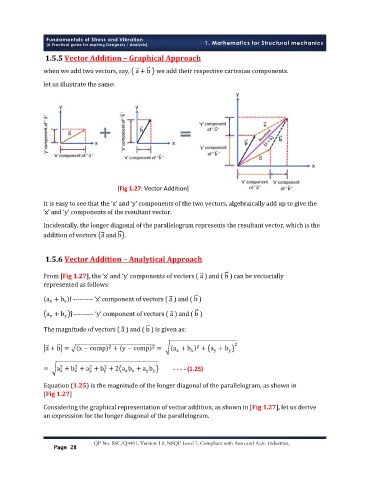
when we add two vectors, say, a + b we add their respective cartesian components.
let us illustrate the same:
[Fig 1.27: Vector Addition]
It is easy to see that the ‘x’ and ‘y’ components of the two vectors, algebraically add up to give the
‘x’ and ‘y’ components of the resultant vector.
Incidentally, the longer diagonal of the parallelogram represents the resultant vector, which is the
addition of vectors a and b .
ͳǤͷǤ
–
From [Fig 1.27], the ‘x’ and ‘y’ components of vectors ( a ) and ( b ) can be vectorially
represented as follows:
a + b i --------- ‘x’ component of vectors ( a ) and ( b )
x
x
a + b j --------- ‘y’ component of vectors ( a ) and ( b )
y
y
The magnitude of vectors ( a ) and ( b ) is given as:
2
a + b = x − comp + y − comp = a + b + a + b
2
2
2
y
x
x
y
= a + b + a + b + 2 a b + a b - - - - (1.25)
2
2
2
2
y
x
x
x x
y y
y
Equation (1.25) is the magnitude of the longer diagonal of the parallelogram, as shown in
[Fig 1.27]
Considering the graphical representation of vector addition, as shown in [Fig 1.27], let us derive
an expression for the longer diagonal of the parallelogram.
QP No. SSC/Q4401, Version 1.0, NSQF Level 7, Compliant with Aero and Auto Industries,
Page 28

