Page 14 - C:\Users\trainee\AppData\Local\Temp\msoEAA3.tmp
P. 14
Document Title
                Fundamentals of Stress and Vibration                                  Chapter Title
                [A Practical guide for aspiring Designers / Analysts]              2. Engineering Mechanics


                 Š‹• ƒ’’Ž‹‡• ‡˜‡ –‘ ƒ ‹…Ž‹‡† •–”ƒ‹‰Š– Ž‹‡Ǥ  ‘™‡˜‡”ǡ ‘‡ ƒ••—’–‹‘ –Šƒ– ™‡ Šƒ˜‡ ƒ†‡ ‹• –Šƒ–ǡ
                –Ї  …‡–”‹ˆ—‰ƒŽ  ˆ‘”…‡ǡ  –Šƒ–  ‹…”‡ƒ•‡•  –Ї  ‘”ƒŽ  ”‡ƒ…–‹‘  ‹•  ‘–  ƒ……‘—–‡†  ˆ‘”Ǥ   Š‹•  ‹•  –‘  ƒ˜‘‹†
                ƒ–Їƒ–‹…ƒŽ …‘’Ž‡š‹–›Ǥ  Š‹• ƒ••—’–‹‘ †‘‡• ‘– •‹‰‹ϐ‹…ƒ–Ž› ƒŽ–‡” –Ї ”‡•—Ž– ˆ‘” …—”˜‡• ™‹–Š
                Žƒ”‰‡ ”ƒ†‹—• ƒ† ‘†‡”ƒ–‡ ˜‡Ž‘…‹–›Ǥ

                 ‘Ž—–‹‘ ȋ…‘–ǥȌǣ „› ‡‡”‰› „ƒŽƒ…‡ ȋ‡‰Ž‡…–‹‰ ‡‡”‰› Ž‘•– ‹ …‘ŽŽ‹•‹‘Ȍǡ ™‡ ‰‡–ǣ

                 Initial potential energy = frictional work done + final potential energy + spring work done

                                                    1
                                                        2
                =  mgH = μmg L + mg h + x sinθ  +  kx         - - - - (2.12)
                                                    2
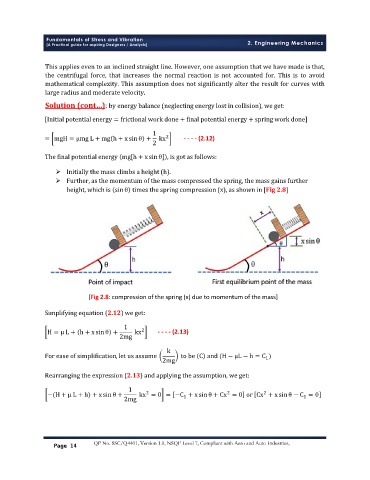
                The final potential energy  mg h + x sin θ  , is got as follows:

                   Ø  Initially the mass climbs a height (h).
                   Ø  Further, as the momentum of the mass compressed the spring, the mass gains further
                       height, which is  sinθ  times the spring compression (x), as shown in [Fig 2.8]


                              [Fig 2.8: compression of the spring (x) due to momentum of the mass]


                Simplifying equation (2.12) we get:

                                          1
                                                2
                 H = μ L +  h + x sinθ  +     kx     - - - - (2.13)
                                         2mg
                                                        k
                For ease of simplification, let us assume       to be  C  and (H − μL − h = C )
                                                                                         1
                                                       2mg
                Rearranging the expression (2.13) and applying the assumption, we get:

                                            1
                                                                                        2
                                                                            2
                                                 2
                 −(H + μ L + h) + x sin θ +     kx = 0  =  −C + x sinθ + Cx = 0  or  Cx + x sinθ − C = 0
                                                              1
                                                                                                     1
                                          2mg


                   Page 14      QP No. SSC/Q4401, Version 1.0, NSQF Level 7, Compliant with Aero and Auto Industries,
   9   10   11   12   13   14   15   16   17   18   19