


Page 15 - C:\Users\trainee\AppData\Local\Temp\msoEAA3.tmp
P. 15
Document Title
                 Fundamentals of Stress and Vibration                              2. Engineering Mechanics   Chapter
                 [A Practical guide for aspiring Designers / Analysts]

                Solving the above quadratic equation, we get:


                                  2
                     − sinθ ±  sin θ + 4CC 1
                 x =
                               2C
                For the spring compression (x) to be positive, ‘C ’ must be greater than zero, that is:
                                                             1
                 H − μL − h > 0 , therefore, we get:   H > μL + h
                The spring compression is now given by the positive root, as follows:


                         2
                      sin θ + 4CC − sinθ
                 x =              1
                              2C


                2.5.3 The 3 Equation of motion

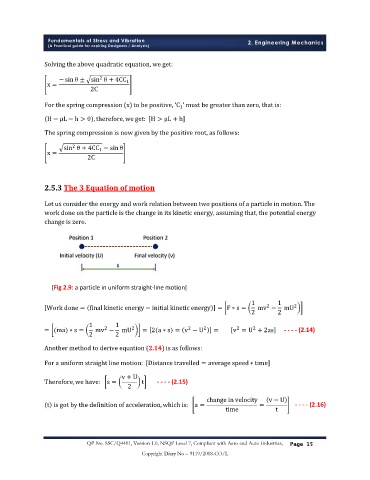
                Let us consider the energy and work relation between two positions of a particle in motion. The
                work done on the particle is the change in its kinetic energy, assuming that, the potential energy
                change is zero.


                  [Fig 2.9: a particle in uniform straight-line motion]

                                                                                    1        1
                                                                                         2
                                                                                                  2
                 Work done =  final kinetic energy − initial kinetic energy   =  F ∗ s =    mv −  mU
                                                                                    2        2
                              1        1
                =  (ma) ∗ s =    mv −  mU    =  2(a ∗ s) =  v − U    =        v = U + 2as   - - - - (2.14)
                                             2
                                                               2
                                                                                     2
                                                                    2
                                    2
                                                                               2
                              2        2
                Another method to derive equation (2.14) is as follows:
                For a uniform straight line motion:   Distance travelled = average speed ∗ time
                                         v + U
                Therefore, we have:    s =      t    - - - - (2.15)
                                           2
                                                                     change in velocity   v − U
                 t  is got by the definition of acceleration, which is:    a =         =            - - - - (2.16)
                                                                            time            t


                              QP No. SSC/Q4401, Version 1.0, NSQF Level 7, Compliant with Aero and Auto Industries,   Page 15 age 15
                                                                                                 P
                                                Copyright Diary No – 9119/2018-CO/L

