


Page 166 - C:\Users\trainee\AppData\Local\Temp\msoEAA3.tmp
P. 166
Fundamentals of Stress and Vibration 1. Mathematics for Structural mechanics
[A Practical guide for aspiring Designers / Analysts]
ϐ
ȋǡȌ
Ǯǯ Ǯǯ Ǥ
ǡ
Ǥ
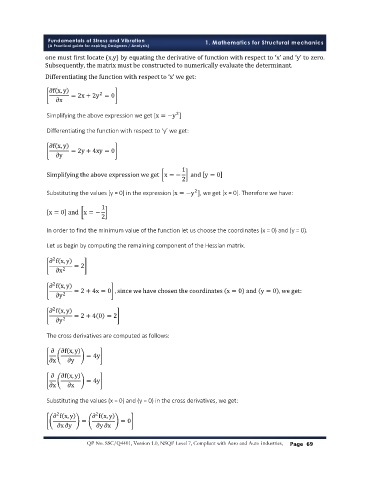
Ǯǯ ǣ
∂f x, y
2
= 2x + 2y = 0
∂x
Simplifying the above expression we get [x = −y ]
2
Differentiating the function with respect to ‘y’ we get:
∂f x, y
= 2y + 4xy = 0
∂y
1
Simplifying the above expression we get x = − and y = 0
2
Substituting the values [y = 0] in the expression [x = −y ], we get [x = 0]. Therefore we have:
2
1
x = 0 and x = −
2
In order to find the minimum value of the function let us choose the coordinates (x = 0) and (y = 0).
Let us begin by computing the remaining component of the Hessian matrix.
2
∂ f x, y
= 2
∂x 2
2
∂ f x, y
= 2 + 4x = 0 , since we have chosen the coordinates x = 0 and y = 0 , we get:
∂y 2
2
∂ f x, y
= 2 + 4 0 = 2
∂y 2
The cross derivatives are computed as follows:
∂ ∂f x, y
= 4y
∂x ∂y
∂ ∂f x, y
= 4y
∂x ∂x
Substituting the values (x = 0) and (y = 0) in the cross derivatives, we get:
2
2
∂ f x, y ∂ f x, y
= = 0
∂x ∂y ∂y ∂x
QP No. SSC/Q4401, Version 1.0, NSQF Level 7, Compliant with Aero and Auto Industries, Page 69

