


Page 45 - C:\Users\trainee\AppData\Local\Temp\msoEAA3.tmp
P. 45
Document Title
                 Fundamentals of Stress and Vibration                              2. Engineering Mechanics   Chapter
                 [A Practical guide for aspiring Designers / Analysts]


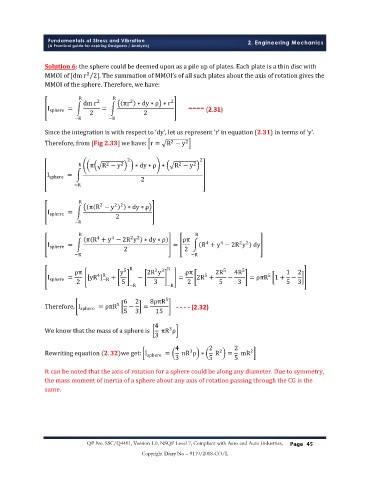
                Solution 6: the sphere could be deemed upon as a pile up of plates. Each plate is a thin disc with
                              2
                MMOI of [dm r   2]. The summation of MMOI’s of all such plates about the axis of rotation gives the
                MMOI of the sphere. Therefore, we have:

                           R          R
                                            2
                             dm r 2       πr   ∗ dy ∗ ρ  ∗ r 2
                 I     =           =
                 sphere
                               2                 2
                          −R         −R
                Since the integration is with respect to ‘dy’, let us represent ‘r’ in equation (2.31) in terms of ‘y’.
                Therefore, from [Fig 2.33] we have:  r =  R − y
                                                              2
                                                          2
                                           2                       2
                           R   π  R − y     ∗ dy ∗ ρ  ∗   R − y
                                    2
                                                                 2
                                         2
                                                            2

                 I
                  sphere  =                     2
                          −R

                           R
                                  2
                                       2 2
                               π R − y     ∗ dy ∗ ρ
                 I     =
                 sphere
                                       2
                          −R
                           R                                      R
                                            2 2
                                 4
                                      4
                              π R + y − 2R y   ∗ dy ∗ ρ      ρπ
                                                                     4
                                                                                2 2
                                                                          4
                 I sphere  =                               =          + y − 2R y   dy
                                          2                   2
                          −R                                    −R
                                                    2 3
                          ρπ             y 5  R   2R y  R     ρπ        2R 5   4R 5             1   2
                                 4 R
                                                                                          5
                                                                     5
                 I sphere  =     yR    +       −             =    2R +      −       = ρπR  1 + −
                          2        −R    5          3          2         5      3               5   3
                                            −R          −R
                                          6   2    8ρπR 5
                                        5
                Therefore,  I     = ρπR   −   =             - - - - (2.32)
                            sphere
                                          5   3      15
                                                    4
                                                         3
                We know that the mass of a sphere is     πR ρ
                                                    3
                                                           4          2        2
                                                                3
                                                                                    2
                                                                          2
                Rewriting equation    .      we get:  I  =    πR ρ  ∗    R   =  mR
                                                  sphere
                                                           3          5        5
                It can be noted that the axis of rotation for a sphere could be along any diameter. Due to symmetry,
                the mass moment of inertia of a sphere about any axis of rotation passing through the CG is the
                same.


                              QP No. SSC/Q4401, Version 1.0, NSQF Level 7, Compliant with Aero and Auto Industries,   P
                                                                                                 Page 45 age 45
                                                Copyright Diary No – 9119/2018-CO/L

