


Page 50 - C:\Users\trainee\AppData\Local\Temp\msoEAA3.tmp
P. 50
Document Title
                Fundamentals of Stress and Vibration                                  Chapter Title
                [A Practical guide for aspiring Designers / Analysts]              2. Engineering Mechanics

                The rod is given an angular acceleration ‘α’, about the vertical axis. Consider an element on the rod
                with coordinates (x, y). This element experiences a linear acceleration  αx . Therefore, the linear
                inertia of the element is given by  dmαx .

                The linear inertia has a moment about both ‘x and y-axis’, given by:

                About the ‘x-axis’ =  dmαx ∗ y

                About the ‘y-axis’ =  dmαx ∗ x

                Therefore, if we sum up the contributions of all the elements along the length of the rod, we would
                get two inertia terms:


                                           2
                    1)    dmαx = α   dmx
                               2
                    2)    dmαxy = α   dmxy
                The first term gives the inertia of the rod about the ‘y-axis’. However, the second term is called the
                cross product of inertia, as, it contains two coordinates (x and y).

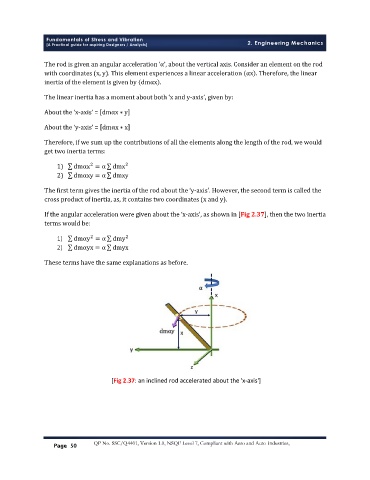
                If the angular acceleration were given about the ‘x-axis’, as shown in [Fig 2.37], then the two inertia
                terms would be:

                                           2
                               2
                    1)    dmαy = α   dmy
                    2)    dmαyx = α   dmyx
                These terms have the same explanations as before.


                                      [Fig 2.37: an inclined rod accelerated about the 'x-axis']


                   Page 50      QP No. SSC/Q4401, Version 1.0, NSQF Level 7, Compliant with Aero and Auto Industries,

