


Page 46 - C:\Users\trainee\AppData\Local\Temp\msoEAA3.tmp
P. 46
Document Title
                Fundamentals of Stress and Vibration                                  Chapter Title
                [A Practical guide for aspiring Designers / Analysts]              2. Engineering Mechanics


                2.6.2 Parallel and Perpendicular axis theorem

                The axes of rotation need not always pass through the CG. For example, the axis of rotation for a
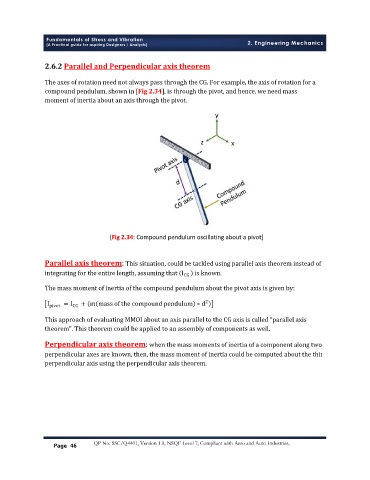
                compound pendulum, shown in [Fig 2.34], is through the pivot, and hence, we need mass
                moment of inertia about an axis through the pivot.


                                     [Fig 2.34: Compound pendulum oscillating about a pivot]


                Parallel axis theorem: This situation, could be tackled using parallel axis theorem instead of
                integrating for the entire length, assuming that  I CG   is known.
                The mass moment of inertia of the compound pendulum about the pivot axis is given by:


                                                                     2
                 I pivot  = I CG  +  m mass of the compound pendulum  ∗ d
                This approach of evaluating MMOI about an axis parallel to the CG axis is called “parallel axis
                theorem”. This theorem could be applied to an assembly of components as well.

                Perpendicular axis theorem: when the mass moments of inertia of a component along two
                perpendicular axes are known, then, the mass moment of inertia could be computed about the third
                perpendicular axis using the perpendicular axis theorem.


                   Page 46      QP No. SSC/Q4401, Version 1.0, NSQF Level 7, Compliant with Aero and Auto Industries,

