


Page 53 - C:\Users\trainee\AppData\Local\Temp\msoEAA3.tmp
P. 53
Document Title
                 Fundamentals of Stress and Vibration                              2. Engineering Mechanics   Chapter
                 [A Practical guide for aspiring Designers / Analysts]


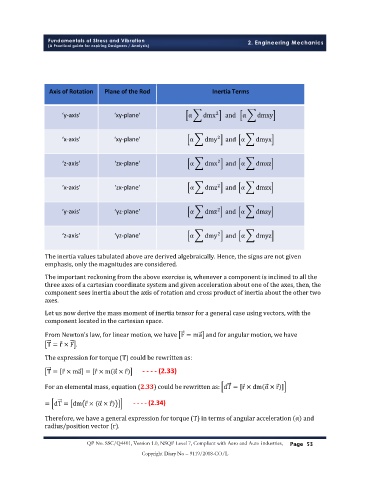
                 Axis of Rotation   Plane of the Rod                   Inertia Terms


                      ‘y-axis’         ‘xy-plane’               α   dmx    and    α   dmxy
                                                                        2


                      ‘x-axis’         ‘xy-plane’               α   dmy    and   α   dmyx
                                                                         2


                      ‘z-axis’         ‘zx-plane’               α   dmx    and   α   dmxz
                                                                         2


                      ‘x-axis’         ‘zx-plane’               α   dmz    and   α   dmzx
                                                                         2


                                                                         2
                      ‘y-axis’         ‘yz-plane’               α   dmz    and   α   dmzy


                      ‘z-axis’         ‘yz-plane’               α   dmy    and   α   dmyz
                                                                         2

                The inertia values tabulated above are derived algebraically. Hence, the signs are not given
                emphasis, only the magnitudes are considered.
                The important reckoning from the above exercise is, whenever a component is inclined to all the
                three axes of a cartesian coordinate system and given acceleration about one of the axes, then, the
                component sees inertia about the axis of rotation and cross product of inertia about the other two
                axes.

                Let us now derive the mass moment of inertia tensor for a general case using vectors, with the
                component located in the cartesian space.

                From Newton’s law, for linear motion, we have  F = ma    and for angular motion, we have


                 T = r  × F .
                The expression for torque (T) could be rewritten as:


                 T =  r  × ma    = [r  × m α    × r      - - - - (2.33)

                For an elemental mass, equation (2.33) could be rewritten as:  dT =  r  × dm α    × r

                =  dT =  dm r  ×  α    × r        - - - - (2.34)
                Therefore, we have a general expression for torque (T) in terms of angular acceleration  α  and
                radius/position vector (r).


                              QP No. SSC/Q4401, Version 1.0, NSQF Level 7, Compliant with Aero and Auto Industries,   P
                                                                                                 Page 53 age 53
                                                Copyright Diary No – 9119/2018-CO/L

