


Page 55 - C:\Users\trainee\AppData\Local\Temp\msoEAA3.tmp
P. 55
Document Title
                 Fundamentals of Stress and Vibration                              2. Engineering Mechanics   Chapter
                 [A Practical guide for aspiring Designers / Analysts]


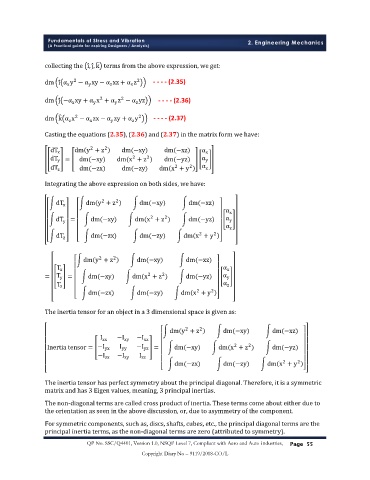
                  collecting the  i , j , k  terms from the above expression, we get:
                dm  i  α y − α xy − α xz + α z      - - - - (2.35)
                         2
                                              2
                                     z
                              y
                                            x
                       x
                dm  j  −α xy + α x + α z − α yz     - - - - (2.36)
                                         2
                                  2
                         x
                                y
                                       y
                                              z
                dm  k α x − α zx − α zy + α y     - - - - (2.37)

                                               2
                          2
                        z
                               x
                                      y
                                             z
                Casting the equations (2.35), (2.36) and (2.37) in the matrix form we have:
                                    2
                               2
                  dT x    dm y + z       dm(−xy)       dm(−xz)      α x
                                             2
                                                  2
                  dT   =   dm(−xy)      dm(x + z )     dm(−yz)    α
                                                                     y
                    y
                  dT z     dm(−zx)       dm(−zy)      dm x + y      α z
                                                                2
                                                           2
                Integrating the above expression on both sides, we have:
                     dT       dm y + z         dm(−xy)         dm(−xz)
                                   2
                                       2
                      x                                                     α
                                                   2   2                     x
                                                                             y

                     dT =      dm(−xy)       dm(x + z )        dm(−yz)      α
                      y
                                                                            α z

                                                                        2
                                                                   2
                    dT z         dm(−zx)       dm(−zy)        dm x + y

                             dm y + z         dm(−xy)         dm(−xz)
                                      2
                                  2
                     T                                                     α
                     x                                                      x
                                                  2
                                                       2
                =  T   =       dm(−xy)       dm(x + z )       dm(−yz)      α
                     y
                                                                            y


                    T z                                                    α z
                                                                       2
                                                                  2
                               dm(−zx)        dm(−zy)        dm x + y

                The inertia tensor for an object in a 3 dimensional space is given as:
                                                         dm y + z          dm(−xy)         dm(−xz)
                                                                   2
                                                              2
                                  I     −I    −I
                                   xx    I  xy   xz                           2    2
                                                 yz
                  Inertia tensor =  −I yx  yy  −I   =       dm(−xy)      dm(x + z )        dm(−yz)
                                 −I zx  −I zy  I zz
                                                                                                   2
                                                                                               2
                                                           dm(−zx)         dm(−zy)       dm x + y

                The inertia tensor has perfect symmetry about the principal diagonal. Therefore, it is a symmetric
                matrix and has 3 Eigen values, meaning, 3 principal inertias.
                The non-diagonal terms are called cross product of inertia. These terms come about either due to
                the orientation as seen in the above discussion, or, due to asymmetry of the component.
                For symmetric components, such as, discs, shafts, cubes, etc., the principal diagonal terms are the
                principal inertia terms, as the non-diagonal terms are zero (attributed to symmetry).
                              QP No. SSC/Q4401, Version 1.0, NSQF Level 7, Compliant with Aero and Auto Industries,   Page 55 age 55
                                                                                                 P
                                                Copyright Diary No – 9119/2018-CO/L

